Many AI systems appear successful during pilots but quietly fail in production. The issue is rarely model quality alone. In most cases, failure stems from how evaluation is designed — or not designed — into the system. Understanding why evaluation breaks down after deployment is the first step toward building AI that actually holds up at scale.
The Illusion of Successful Pilots
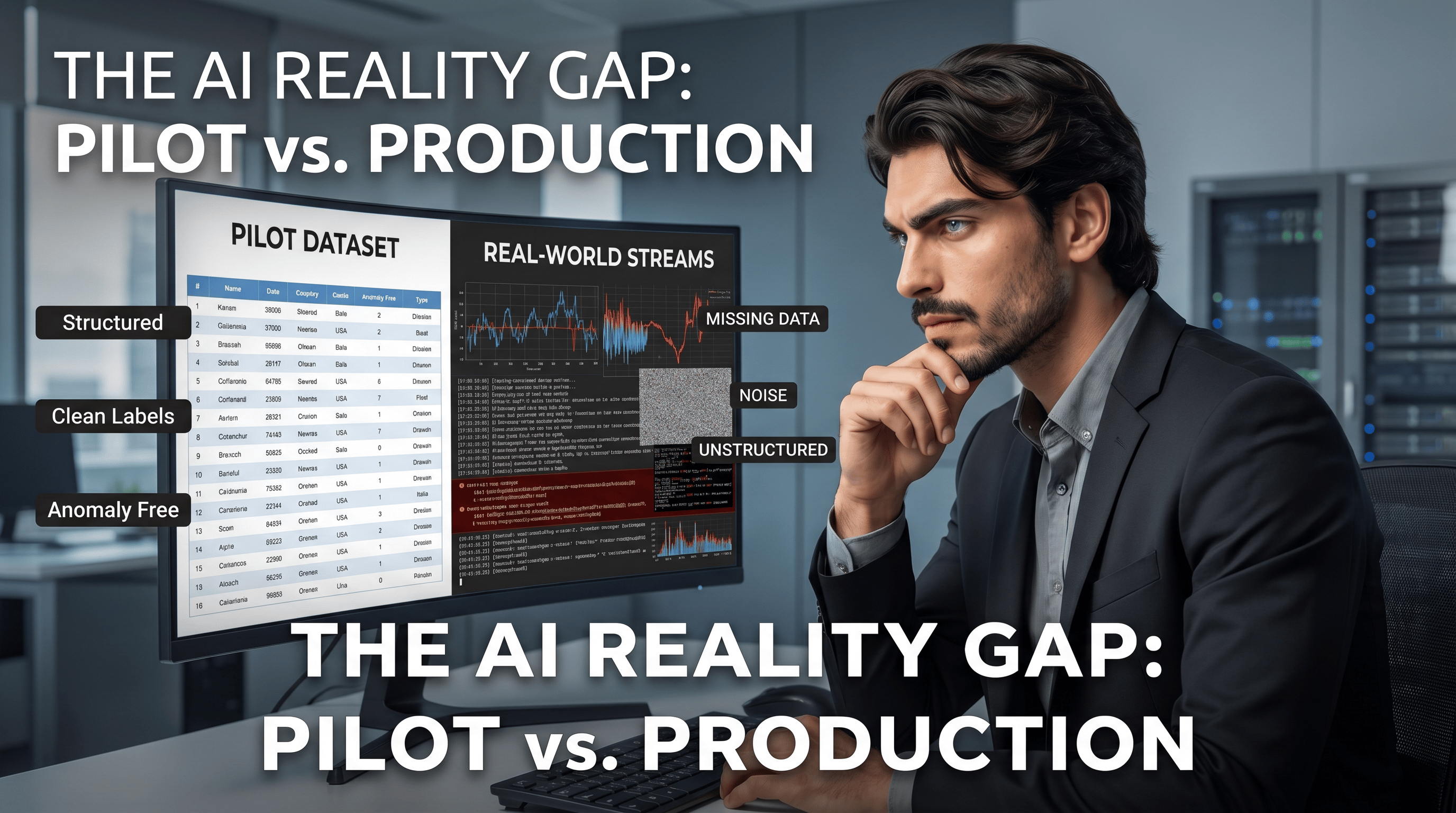
AI pilots are optimized for success. They typically involve clean or curated data, narrow scopes, short timeframes, manual oversight, and friendly evaluation criteria. These conditions are not representative of production environments — they're designed to make a system look good, not to stress-test it.
When systems move into production, they encounter messy inputs, changing behavior patterns, scale effects, latency and cost constraints, and real user incentives that were never present in the pilot. Evaluation mechanisms that worked under controlled conditions often do not survive contact with reality.
"A pilot that succeeds under ideal conditions tells you the model works. It tells you nothing about whether the system will hold in production."
The gap between pilot performance and production performance is not a model problem. It is an architectural problem — one that begins with how evaluation is structured before a single line of code is written.
The Core Reasons Evaluation Fails
1. Evaluation Is Treated as a Phase, Not a System
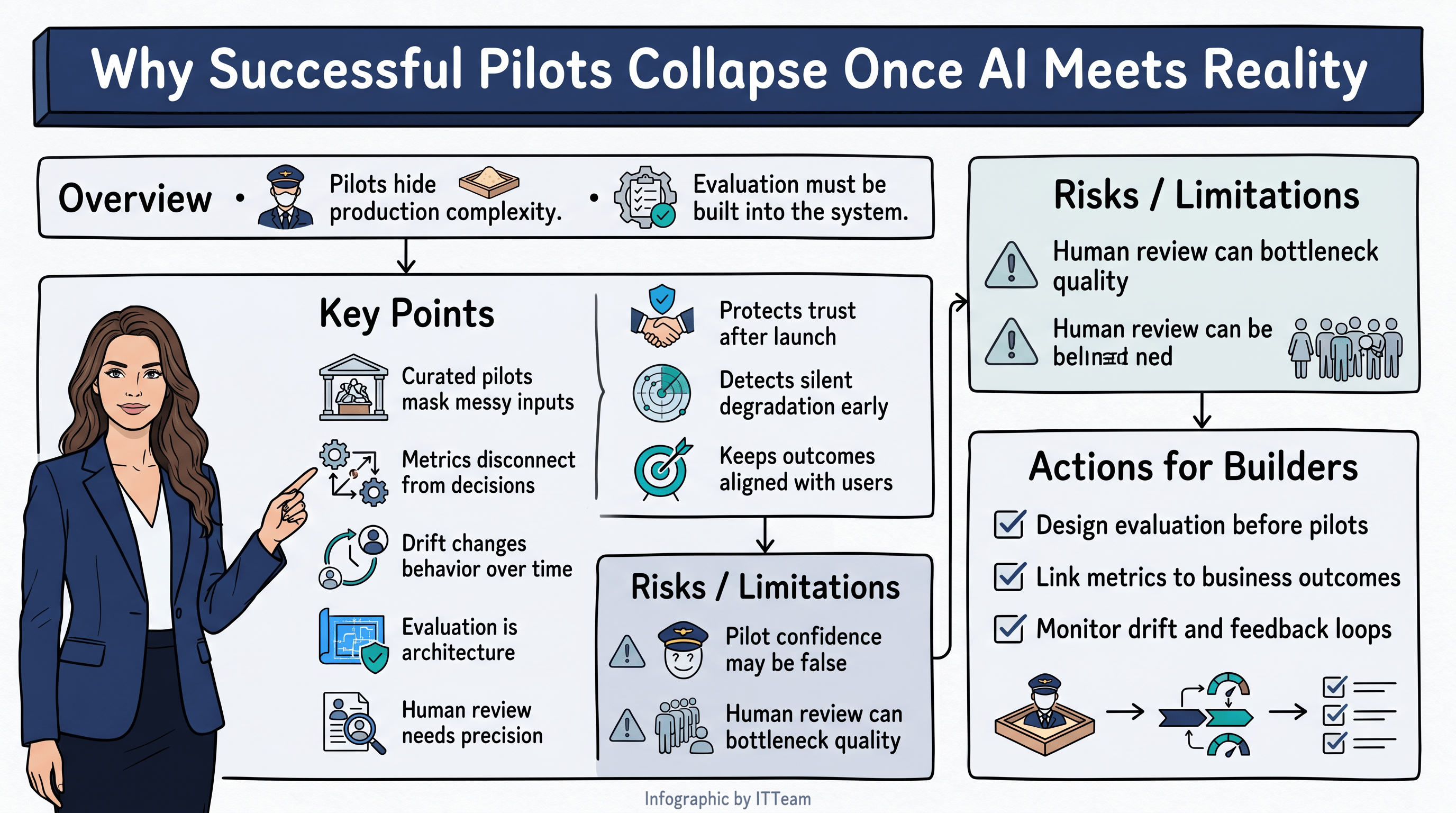
Many teams treat evaluation as something that happens before launch, at milestone reviews, or during audits. This is fundamentally the wrong framing. In production AI systems, evaluation must be continuous and structural — not an event that occurs at discrete intervals.
When evaluation is not embedded into the architecture, degradation goes unnoticed until trust is already lost. By the time someone asks "why is the system performing worse?" the damage has been accumulating for weeks or months, and there is no trace of when or why it started.
2. Metrics Are Disconnected from Decisions
Common evaluation metrics — accuracy, precision and recall, confidence scores, token-level measures — are well understood and widely tracked. But in isolation, they rarely influence real decisions. A metric that does not determine whether the system proceeds, stops, escalates, or defers is not a control mechanism. It is informational noise.
The test of a meaningful metric
If a metric crosses a threshold and nothing in the system changes as a result, that metric is not doing evaluation work. It is producing data that someone may eventually read.
Effective evaluation requires metrics that are wired directly into system behavior — gates that route, hold, escalate, or terminate based on measured conditions. A dashboard is not an evaluation system. An architecture that responds to measurement is.
3. Quality Is Undefined or Context-Free
Many AI systems are deployed without a shared, explicit definition of what "good output" means in context. Quality varies by use case, risk level, user role, and stage in the workflow. A response that is appropriate for a low-stakes internal tool may be entirely unacceptable for a customer-facing decision.
Without contextual quality definitions, evaluation becomes subjective, inconsistent, or irrelevant. Different reviewers apply different standards. The same output passes one day and fails the next. Over time, the evaluation signal degrades into noise — and with it, any meaningful accountability for system behavior.
4. Human-in-the-Loop Is Applied Indiscriminately
Human review is frequently used as a catch-all safety net — applied broadly, without structured criteria for when it is necessary, what it should assess, or how reviewers should respond to what they find. This leads to bottlenecks, reviewer fatigue, inconsistent judgments, and escalation of low-value cases that consume capacity needed elsewhere.
Human-in-the-loop is a valuable mechanism when targeted and intentional. It is an expensive liability when used as a blanket fallback. The decision about when human judgment is required — and what specific judgment is being asked for — is an architectural decision that must be made deliberately, not defaulted to.
5. No Mechanism Exists to Detect Degradation Over Time
Production AI systems change — even when the model does not. Data drift, behavior shifts, prompt decay, edge-case accumulation, and feedback loops all introduce gradual changes in system performance that compound over time. Without monitoring and evaluation loops designed to detect these signals, systems slowly lose quality without triggering alarms.
The failure mode is not dramatic. Output quality slips incrementally. Reviewers start spending more time on corrections. Stakeholders lose confidence in specific output types. By the time the problem is visible, the organization has been operating on degraded AI for long enough that no one can easily identify the cause.
Evaluation in Production Is an Architectural Problem
Evaluation failure is not a tooling issue. It is not solved by adding a new monitoring dashboard, running more frequent human reviews, or switching evaluation frameworks. It is a consequence of architectures that assume static behavior, optimize for initial performance, lack feedback channels, and cannot express uncertainty or failure modes.
Effective evaluation requires designing for uncertainty — building systems that expect to be wrong in unknown ways, that produce structured signals when they are, and that have defined responses to those signals. This is not a quality assurance exercise. It is a core architectural discipline.
- Architectures that assume static behavior have no mechanism to detect when that assumption breaks
- Architectures that optimize for initial performance build toward a benchmark that does not represent production conditions
- Architectures that lack feedback channels cannot learn from production behavior at all
- Architectures that cannot express failure modes cannot route around them or escalate them appropriately
What Production-Grade Evaluation Actually Requires
Production evaluation must be continuous — not event-based — so that degradation is detected in real time rather than discovered in retrospect. It must be context-aware, tied to the specific purpose and risk level of each decision the system makes. It must be decision-linked, so that metrics drive system behavior rather than sitting in dashboards. It must be observable, with failures visible early enough to act on. And it must be scalable, designed so that human effort is preserved for the decisions that genuinely require it.
These properties cannot be retrofitted easily. An architecture that was not designed for continuous evaluation will resist it — the feedback loops aren't there, the measurement points weren't instrumented, the routing logic doesn't exist. This is why evaluation architecture must be planned from the start, not added after the first production incident makes the gap obvious.
The principle that matters
Degradation is inevitable. Detection is optional. Whether your organization catches quality decline before it damages trust depends entirely on whether evaluation was designed into the architecture from the beginning.
How We Build Evaluation Into AI Architecture
In every AI system we design, evaluation architecture is defined before the execution layer is built. We establish what "good" means in each context before writing a single prompt, identify which decisions require human judgment before assigning reviewers, and instrument measurement points before any production data flows through the system.
The question "how will we know if this is working?" must have a structural answer — not a procedural one. Evaluation is not a process that runs beside the system. It is a capability built into it: feedback loops that surface degradation signals, gates that respond to measured conditions, and escalation paths that target human effort where it actually matters.
Organizations that get this right don't just build AI that works in pilots. They build AI that holds up — and can be trusted to hold up — when it meets the full complexity of production at scale.