Most AI outreach initiatives work in demos. Very few survive contact with real-world usage. The gap between the two is almost never the model — it's the architecture underneath it.

When teams build AI outreach systems, they typically start with a single agent that does everything: finds prospects, researches them, scores them, writes the message, and sends it. It works in a controlled environment. It breaks under production load, edge cases, and the inevitable moment someone asks "why did it do that?"
The answer to that question — the ability to explain, audit, and fix AI behavior in a running system — requires architectural decisions that most teams never make because they were too focused on making the demo work. This article is about making those decisions deliberately, before the system is built.
Why Architecture Is the Real Constraint
AI model capability has improved dramatically. The bottleneck in enterprise AI deployments is no longer what the model can do — it's whether the system around the model can scale, adapt, and be governed as requirements change.
The failure modes that kill AI outreach systems in production are architectural, not technical:
- Monolithic "do-everything" agents — one agent handling discovery, intelligence, and execution means a single point of failure, no explainability, and no ability to improve one layer without breaking the others
- Tight coupling between logic, data, and execution — when business rules live inside prompts and prompts drive execution directly, nothing can be audited or changed safely
- Lack of explainability — when you can't trace why a specific prospect was contacted or why a specific message was sent, compliance and quality control become impossible
- Inability to swap models or tools — systems designed around a specific model or vendor become liabilities when that model is deprecated or a better option emerges
- Operational fragility — systems that weren't designed for failure modes degrade silently under real-world conditions rather than surfacing problems clearly
A strong architecture prevents these failures before they happen. Not by limiting what the system can do — but by ensuring the system remains understandable, controllable, and improvable as it operates.
Five Architectural Principles for Agentic Systems
- Separation of concerns. Each agent must have a single responsibility, clear input and output contracts, and no hidden dependencies on other agents' internal state. This allows any individual agent to evolve, be replaced, or be debugged without cascading changes across the system. A discovery agent discovers. An intelligence agent reasons. An execution agent acts. None of them do each other's jobs.
- Explicit quality gates. Progression through the system must be governed by defined decision points, not implicit assumptions. Leads, data, and actions move forward only when they meet explicit quality thresholds — not because the previous stage completed. This is the mechanism that protects downstream agents and human attention from the consequences of upstream failures.
- Intelligence before execution. Execution agents should never decide what to do — only how to do it. All prioritization, scoring, relevance assessment, and readiness checks must occur in the intelligence layer, upstream of any action. This keeps execution deterministic: given a qualified input and an approved decision, the execution agent always behaves the same way. That predictability is what makes the system auditable.
- Stateless execution, stateful intelligence. The intelligence layer maintains context, memory, and scoring state. The execution layer is stateless — it receives everything it needs to act and does exactly that. Mixing these concerns creates systems where the execution layer makes implicit decisions based on retained state, producing behavior that can't be explained or reproduced.
- Model-agnostic design. The architecture must assume that models will change, benchmarks will shift, and vendors will come and go. Business logic, routing rules, and quality criteria should never live inside a model's system prompt. Agents should be designed so that swapping the underlying model requires no changes to workflow logic, data contracts, or downstream behavior.
The Five-Stage Architecture
Applying these principles to B2B outreach produces a staged architecture where each layer has a clearly bounded responsibility and hands off to the next only when its own quality criteria are met.
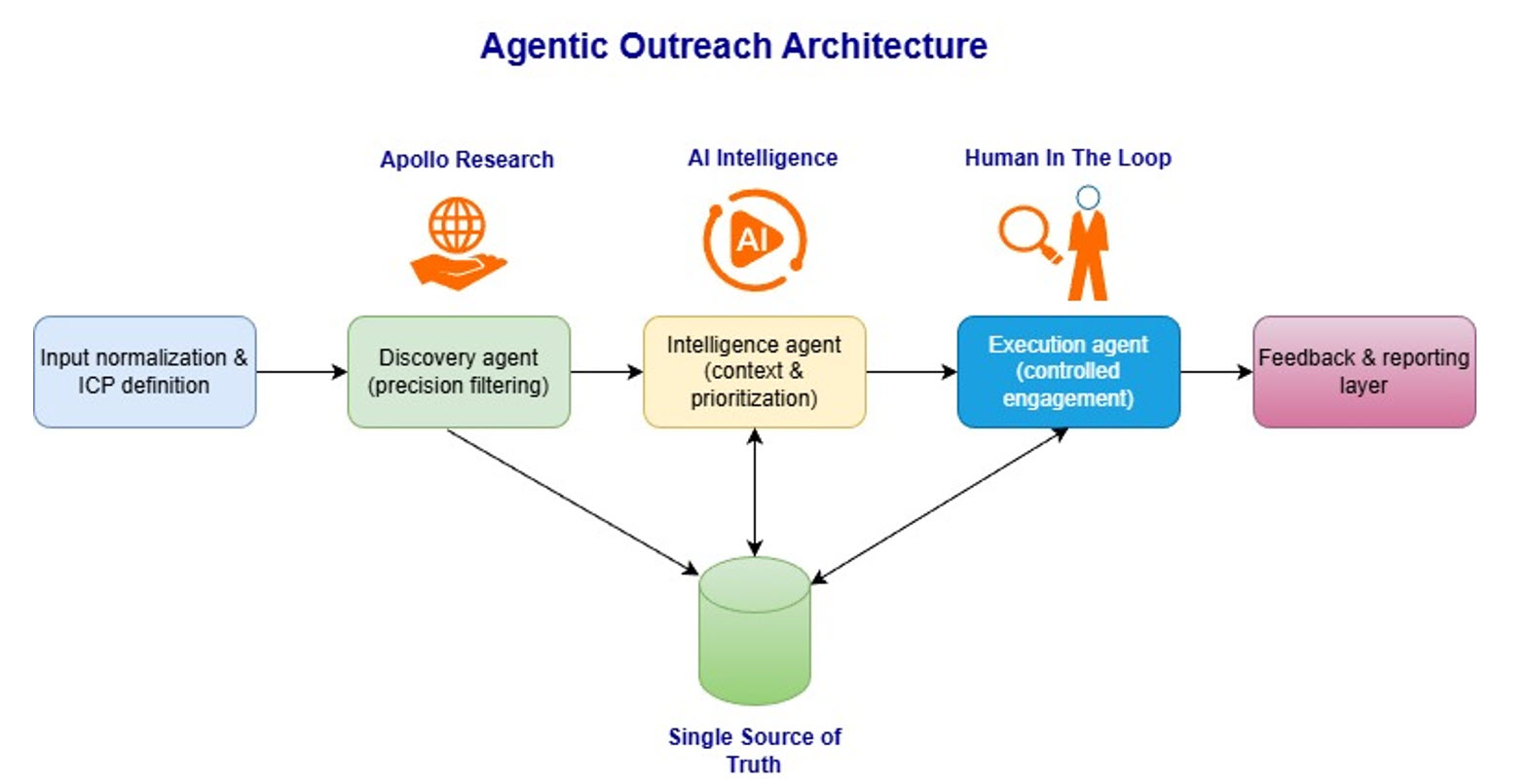
Stage 1: Input Normalization & ICP Definition
Before any agent acts, the system establishes what it is looking for. ICP (Ideal Customer Profile) parameters are defined as explicit, versioned criteria — not embedded in a prompt somewhere. Input data is normalized to a consistent schema. This stage ensures that every downstream agent is operating on clean, structured inputs against a defined target, not inferring intent from ambiguous data.
Stage 2: Discovery Agent (Precision Filtering)
The discovery agent applies ICP criteria to identify candidates that meet the entry threshold. Its only job is filtering — it does not score, prioritize, or prepare messaging. It passes qualified candidates to the next stage and discards everything else. The quality gate here is binary: meets ICP criteria or does not proceed.
Stage 3: Intelligence Agent (Context & Prioritization)
The intelligence agent is the reasoning core of the system. It enriches qualified candidates with context, scores them against readiness and ROI indicators, and produces a structured decision record that includes not just a score but the reasoning behind it. This is the stateful layer — it reads from and writes to the Single Source of Truth, maintaining continuity across interactions. It does not send messages. It decides what deserves to be acted on, and why.
Stage 4: Execution Agent (Controlled Engagement)
The execution agent receives a fully qualified, scored, and approved candidate from the intelligence layer and executes the defined action — message generation, channel selection, timing, delivery. It is stateless: every input it receives contains everything it needs. It has no authority to modify priorities, skip steps, or override gate decisions. Human-in- the-loop controls sit at this layer for use cases where approval is required before action.
Stage 5: Feedback & Reporting Layer
Responses, outcomes, and engagement signals are captured and fed back into the Single Source of Truth, where they update context for the intelligence agent on the next cycle. This closes the loop and creates a system that improves over time based on real signal — not one that repeats the same actions regardless of what has already happened.
What This Architecture Enables — and What It Deliberately Avoids
Because responsibilities are isolated and contracts between agents are explicit, this architecture supports incremental evolution without systemic risk. New agents can be added at any stage. Existing agents can be replaced with better models or different tools. Workflows can be updated without touching layers that aren't changing. Governance and observability remain intact throughout.
The same modularity that enables scale also enables governance. Every decision in the system can be traced to a specific agent, a specific input, and a specific quality threshold. When a compliance team asks why a particular prospect received a particular message on a particular day, the answer exists in the architecture.
The goal is predictable behavior, not impressive outputs. Predictability is what turns a working demo into a production system.
What this architecture deliberately avoids is equally important:
- Monolithic agent designs where a single component owns too much responsibility
- Hidden logic inside prompts that can't be versioned, tested, or audited
- Unbounded autonomy — agents that can decide outside their defined scope
- Tool sprawl without orchestration — integrations that bypass the quality gate layer
- Architecture driven by demo requirements rather than operational requirements
Key takeaway
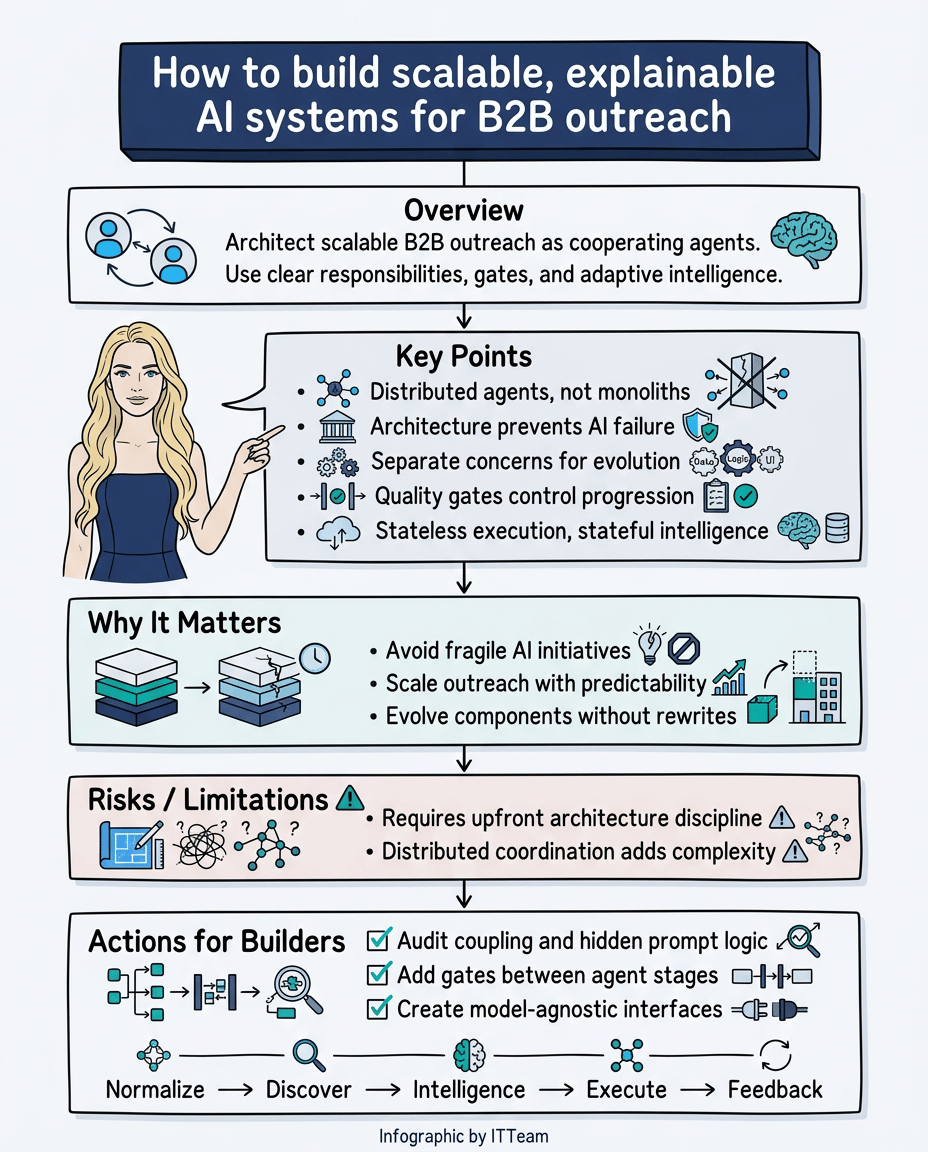
The difference between an AI outreach system that works in a demo and one that works in production is not the model — it's whether the architecture isolates concerns, enforces quality gates, and keeps intelligence upstream of execution. Build for operations, not for the demo.
How We Apply This in Practice
Every agentic system we design starts with a responsibility map — an explicit definition of what each agent owns, what it receives, what it produces, and what it is not allowed to do. That boundary definition happens before any model is selected or any tool is integrated.
The quality gate design follows immediately after. We define the pass/fail criteria for each stage transition, the deferral conditions, and the instrumentation required to observe gate behavior in production. These decisions shape the data model, the orchestration logic, and the observability stack — in that order.
The result is a system where every component has a clear role, every decision is traceable, and every layer can evolve independently as models improve, requirements change, and the business scales. That's the difference between an AI system that was built to impress and one that was built to last.