Most agentic AI systems don't fail dramatically. They degrade quietly. Output quality slips, human reviewers get overwhelmed, costs accumulate invisibly, and trust erodes before anyone can point to a specific cause. The culprit is almost always the same: everything moves forward by default.
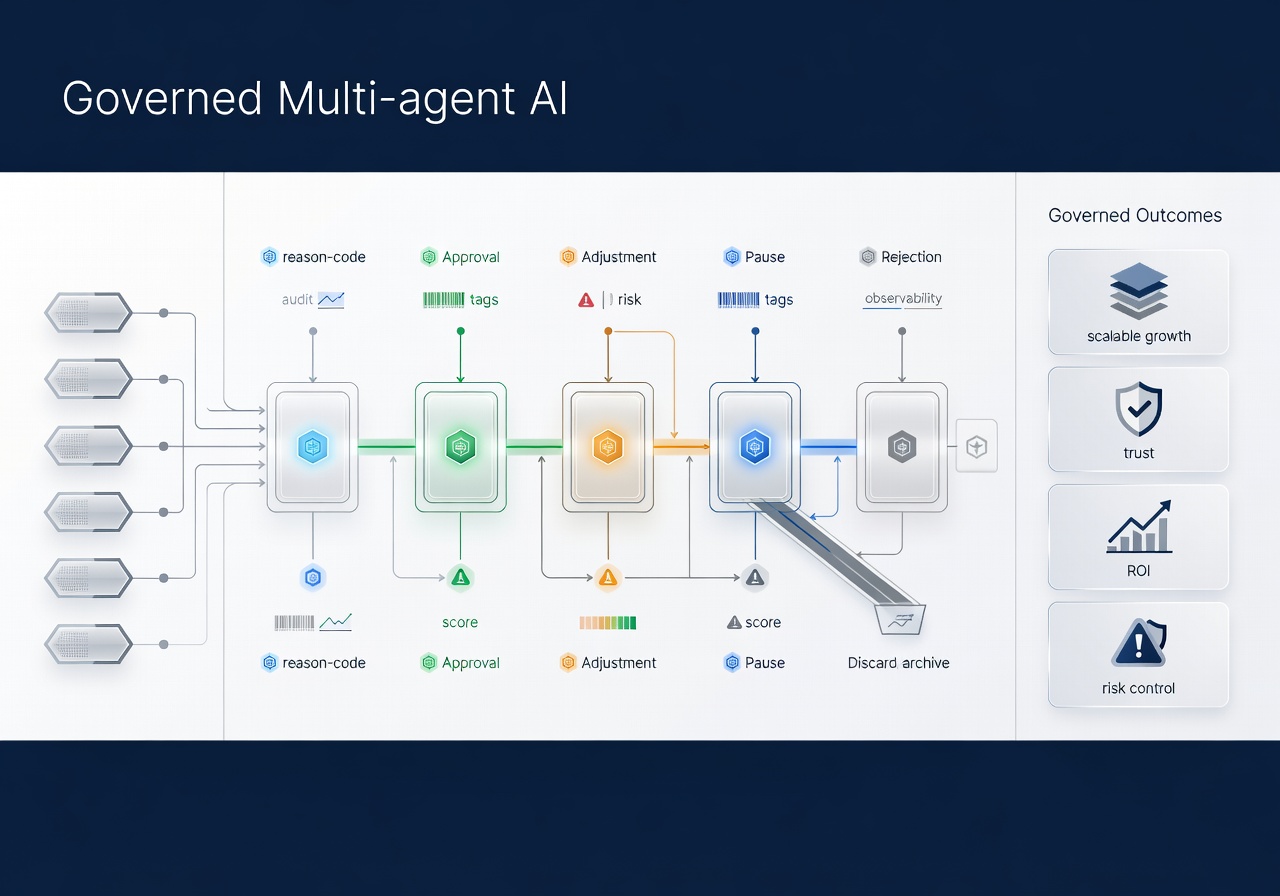
Quality gates are the architectural mechanism that prevents this. They introduce deliberate decision points into agentic workflows — explicit checkpoints that determine whether data, actions, or outputs are ready to proceed, need refinement, should be deferred, or should be discarded entirely. In well-designed agentic systems, quality gates aren't optional safeguards added after the fact. They're foundational structural elements designed in from the start.
Why Agentic Systems Fail Quietly
Traditional software fails loudly. Exceptions are thrown, errors are logged, alerts fire. Agentic systems are different. They are designed to handle ambiguity, to keep moving through uncertainty, to produce output even when inputs are incomplete or conditions are suboptimal. That capability — which makes them powerful — is also what makes them dangerous without the right controls.
When an agentic system has no explicit decision points, it defaults to throughput. Everything passes forward. Low-quality inputs generate low-quality intelligence. Low-quality intelligence generates inappropriate actions. Inappropriate actions consume human attention, damage relationships, and accumulate costs — all while the system continues operating normally from its own perspective.
"An agentic system that processes everything equally is not a high-performing system. It's a noise generator running at scale."
The failure mode isn't a crash. It's a slow, measurable decline in outcomes that gets attributed to the wrong causes — bad data, wrong model, poor prompts — when the real issue is a missing decision architecture.
What a Quality Gate Actually Is
A quality gate is a deliberate evaluation checkpoint that answers one question before allowing the system to proceed:
The core question every gate must answer
"What must be true for this to move forward?" — and if that condition isn't met, what happens instead?
The outcome of a gate evaluation isn't binary. A well-designed gate has four possible outcomes:
- Proceed — the entity meets the defined criteria and continues downstream
- Refine — the entity is returned upstream for enrichment or correction before re-evaluation
- Defer — the entity is held for re-evaluation when conditions change
- Discard — the entity does not meet criteria and is removed from the pipeline
Crucially, quality gates must be explicit, explainable, measurable, and context-aware. They replace implicit assumptions — "the model will figure it out" — with transparent decisions that can be inspected, audited, and adjusted.
This distinction matters enormously for enterprise deployments. A gate whose logic lives inside a prompt cannot be audited. A gate whose threshold was set by intuition cannot be measured. A gate that was never designed — only assumed — cannot be trusted.
The Four Layers Where Gates Belong
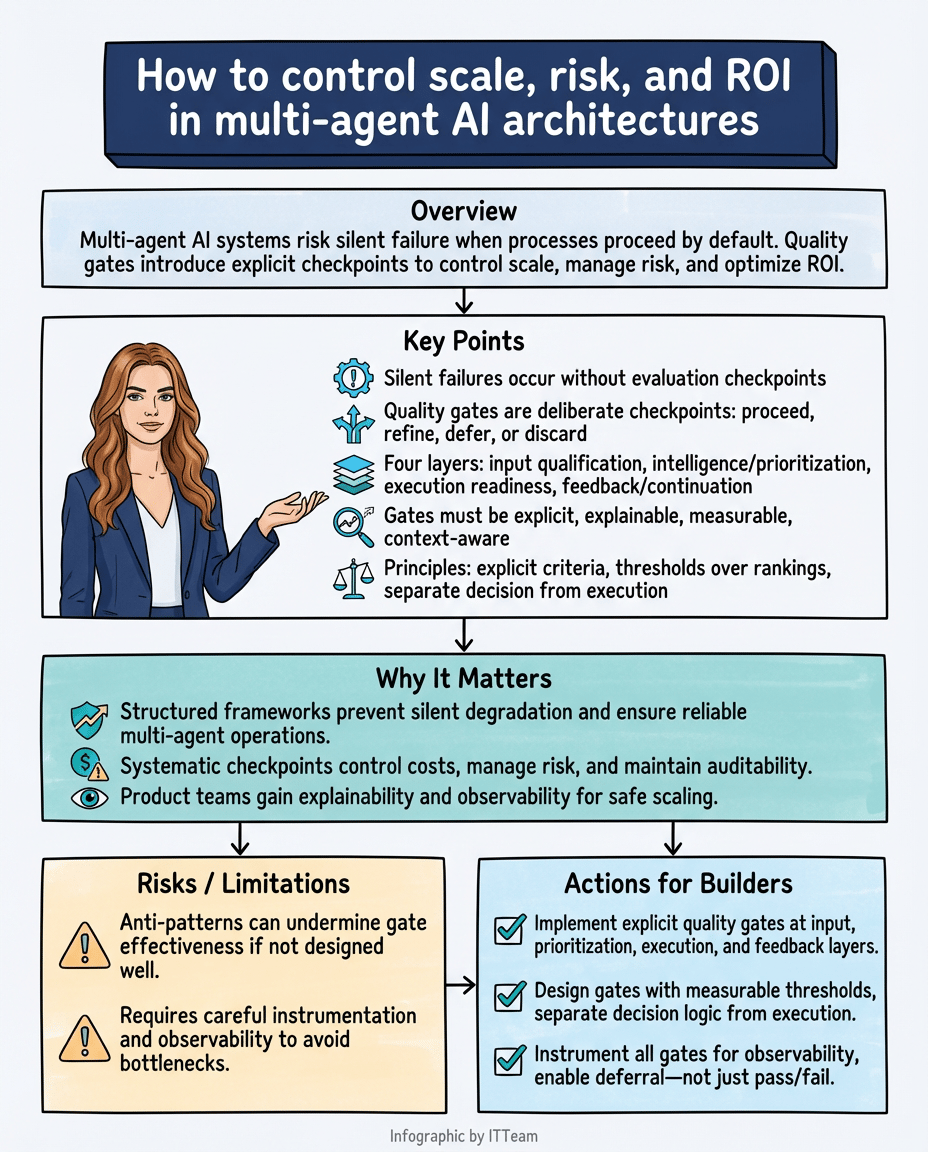
In any production agentic system, quality gates belong at four distinct layers. Each layer protects something different — and missing any one of them creates a different category of failure.
1. Input Qualification Gates
The first gate controls what enters the system at all. Its job is to ensure that only meaningful, complete, relevant inputs reach the intelligence layer. Common criteria include data completeness checks, profile fit validation against defined parameters, and noise filtering to remove malformed or out-of-scope inputs.
This gate is frequently skipped under pressure to maximize throughput. That's a mistake. Every low-quality input that passes this gate doesn't just get processed — it consumes computational resources, contaminates downstream intelligence, and potentially triggers real-world actions that should never have happened. Garbage in, scaled garbage out.
2. Intelligence and Prioritization Gates
Once inputs are qualified, the second gate decides where effort is actually justified. Not every qualified input deserves the same level of processing. This gate evaluates readiness thresholds, ROI potential, and context sufficiency to determine which entities warrant deeper analysis and which should be deferred or handled with lighter-weight processes.
This is where the distinction between rankings and thresholds matters most. A ranking-based approach — "process the top 50" — guarantees that something always moves forward, regardless of whether any of the 50 actually meet the criteria for productive action. A threshold-based approach — "only process entities scoring above X" — enforces a real decision. Some days, zero entities proceed. That's correct behavior, not a system failure.
3. Execution Readiness Gates
The third gate sits immediately upstream of any action the system takes in the real world — sending a message, making an API call, updating a record, triggering a downstream process. Its job is to prevent premature or inappropriate execution.
Execution readiness checks include messaging relevance validation, timing appropriateness, channel suitability, and compliance checks specific to the action type. The governing principle is simple: execution should never occur by default. It should occur because a gate explicitly determined it was appropriate.
4. Feedback and Continuation Gates
The final gate determines whether and how the system continues after an action has been taken. It evaluates responses, detects diminishing returns, and enforces stop or pause conditions. Without this gate, agentic systems create two failure modes that are difficult to detect and expensive to recover from: infinite loops and reputation damage from continued engagement after a clear signal to stop.
Five Design Principles for Effective Gates
- Make criteria explicit. Every gate must have a written, reviewable definition of what "pass" means. Ambiguous thresholds — "good enough," "high confidence," "relevant" — produce inconsistent behavior and hide bias in the system's decisions.
- Prefer thresholds over rankings. Rankings guarantee throughput regardless of quality. Thresholds enforce real decisions. If nothing meets the threshold, nothing proceeds. That's the system working correctly.
- Separate decision logic from execution logic. Gate logic should live upstream of the agents that execute actions. Execution agents should never decide their own priorities, override gate outcomes, or introduce undocumented criteria. This separation is what makes agentic systems auditable.
- Design for deferral, not just rejection. Not all failures are permanent. A well-designed gate preserves optionality — entities can be held for re-evaluation when conditions change or new signals appear. Permanent rejection is the right outcome for some entities. Premature rejection of deferrable entities is waste.
- Instrument everything. Every gate should produce pass/fail outcomes, reason codes, and aggregate metrics. If a gate cannot be measured, it cannot be trusted, tuned, or defended to a compliance team. Gate observability is not a nice-to-have — it's the mechanism that makes AI governance operational rather than theoretical.
Anti-Patterns That Recreate the Problem
Organizations that recognize the need for quality gates sometimes implement them in ways that provide the appearance of control without the substance. These anti-patterns are worth naming explicitly because they're common and because they're more dangerous than having no gates at all — they create false confidence.
- Gates embedded inside prompts — prompt-level logic cannot be audited, versioned, or measured independently of model output
- Implicit thresholds based on "confidence scores" — model confidence is not a quality signal; it's a model output that itself requires evaluation
- Overly permissive thresholds set to avoid disruption — a gate that always passes under operational pressure is not a gate
- Execution agents with authority to bypass gates — any pathway that allows execution to occur without gate evaluation defeats the architecture entirely
Each of these anti-patterns recreates monolithic failure modes inside agentic systems — the same silent degradation, just distributed across more components and harder to diagnose.
Quality Gates as a Governance Mechanism
Beyond operational performance, quality gates are the most practical way to operationalize AI governance in agentic systems. Every gate is an explicit, documented, measurable decision point — which is exactly what explainability, auditability, and regulatory compliance require.
When a regulator or an auditor asks "how does this system decide what actions to take?" — a well-gated architecture has a concrete answer. When a business stakeholder asks "why did the system do X?" — gate reason codes provide a traceable answer. When a security team asks "what prevents the system from taking inappropriate action?" — execution readiness gates are the answer.
This is the deeper value of quality gate architecture: it makes the system's decision-making legible to humans who need to oversee, trust, and defend it. That legibility is not a compliance formality. In enterprise AI, it's a prerequisite for sustained adoption.
Architecture principle
Quality gates don't slow agentic systems down. They make scale possible — because they're the mechanism that prevents scale from producing proportionally scaled mistakes.
How We Architect Gates in Practice
In every agentic system we design, gate architecture is part of the initial system design — not an addition made after the first production incident. We define the gate layer before the execution layer, and we require that every gate has an explicit pass condition, a defined set of outcomes (proceed, refine, defer, discard), and instrumentation built in.
The conversation about gate thresholds is also a business conversation, not just a technical one. What's the cost of a false positive at the execution layer? What's the cost of over-deferring at the intelligence layer? These tradeoffs have business answers that should drive the technical configuration — not the other way around.
Agentic systems that scale successfully aren't the ones that process the most. They're the ones with decision architectures rigorous enough to know what shouldn't be processed at all.