Most organizations don't fail at AI because they lack good ideas. They fail because they have too many ideas and no structured way to decide which ones to pursue, in what order, and why.
The symptoms are familiar: dozens of disconnected pilots running in parallel, competing proposals across business units, no shared definition of what "successful AI" actually means, and growing friction between IT, business stakeholders, and security teams. The result is AI investment that becomes reactive rather than strategic — money spent on whatever demo impressed the leadership team last quarter.
AI Ambition Has to Come First
Before any architecture conversation, before any vendor evaluation, before any pilot kicks off, organizations need to make one critical decision explicit: what kind of AI transformation are they actually pursuing?
There are two fundamentally different ambition levels:
Everyday AI targets internal productivity. Document processing, meeting summarization, first-draft generation, data analysis assistance. These use cases have high technical feasibility, lower risk, and faster time-to-value. They don't transform the business — but they reduce friction and build organizational AI literacy.
Game-Changing AI targets core capabilities or customer-facing transformation. Autonomous decision systems, AI-powered products, intelligent supply chain optimization, real-time customer intelligence. These require more complex architectures, stronger governance standards, longer timelines — and offer proportionally higher returns.
Most organizations try to pursue both without being explicit about it. That's where the confusion starts. The architecture, governance, data requirements, security posture, and delivery timelines for these two categories are fundamentally different. Treating them the same guarantees stalled projects and disappointed stakeholders.
The Opportunity Radar: Two Dimensions That Force the Right Conversations
A practical framework — inspired by Gartner's AI Opportunity Radar — maps AI use cases across two dimensions before any technical design begins.
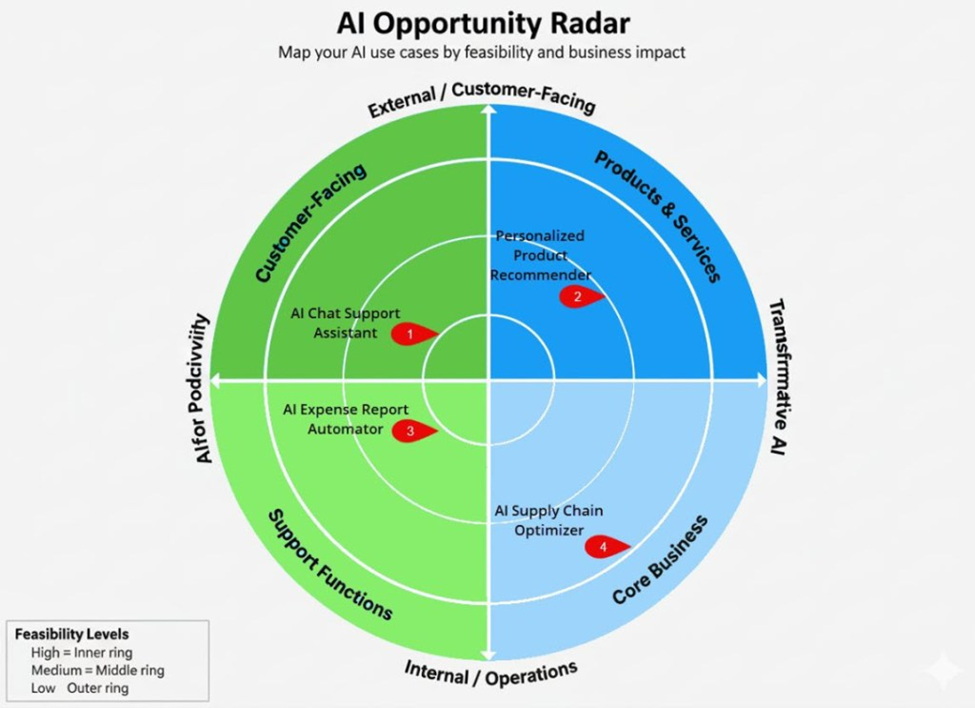
Dimension 1: Opportunity Type
Where does this use case create value?
- Internal operations — cost reduction, process efficiency, error elimination
- Support functions — HR, legal, finance, and back-office automation
- Customer-facing — service quality, engagement, experience improvement
- Core business — products, services, and competitive differentiation
Dimension 2: Feasibility Level
How hard is this to actually deploy and sustain in production?
- High feasibility — mature technology, established patterns, low adoption friction
- Medium feasibility — emerging tech, higher change management requirements, real cost to operationalize
- Low feasibility — unproven approaches, high organizational risk, high potential reward
Plotting candidate use cases on this radar immediately surfaces two things: which ones are safe bets for near-term delivery, and which ones require a longer architectural runway to be viable. More importantly, it forces tradeoff conversations that would otherwise happen implicitly — and badly — late in a project when the cost of changing course is highest.
Feasibility Is Not Just Technical
This is the part most architecture teams get wrong. When organizations assess whether an AI use case is feasible, they almost always focus on technical feasibility — can we build it? But feasibility has three equally important dimensions, and ignoring any one of them causes projects to stall or fail silently.
Technical feasibility — Can you build it and run it at production scale? Do you have the data, the infrastructure, the model access, and the integration points to make this actually work outside a demo environment?
Internal readiness — Will the people and processes actually adopt it? A technically perfect AI system that nobody uses is a failed AI system. Change management, training, workflow redesign, and user experience are as much part of the architecture as model selection or infrastructure choices.
External readiness — Will customers, partners, and regulators accept it? For customer-facing AI, trust and transparency requirements are non-negotiable. For regulated industries, compliance is an architectural constraint that must be designed in from day one — not a checkbox added before go-live.
Architectures that optimize for technical feasibility alone tend to produce systems that either stall in pilot indefinitely or get deployed and quietly abandoned within six months.
The Three Foundational Readiness Pillars
Before any AI use case can be responsibly scaled, three organizational foundations need to be in place. These aren't optional — they determine whether your AI portfolio creates value or creates liability.
1. AI-Ready Security
AI systems introduce attack surfaces that traditional security frameworks weren't designed to address. Prompt injection, data exfiltration through model outputs, adversarial inputs, model supply chain risks, and inference-time manipulation are categories of threat that require specific controls. AI-ready security means updating your threat models, detection capabilities, and response playbooks to account for these — before production deployment, not after the first incident.
2. AI-Ready Data
The quality of your AI output is bounded by the quality of your data. Governed, accurate, unbiased, and contextually appropriate data isn't a nice-to-have — it's the foundational constraint that determines what your AI system can actually do reliably. Organizations that skip this step build AI systems that produce confident-sounding wrong answers at scale. That is worse than no AI at all.
3. AI Principles
Organizations need explicit, written boundaries for what they will and will not do with AI — before they deploy anything significant. These aren't just ethical considerations. They are architectural constraints that determine what systems you can build, what oversight mechanisms are required, what audit trails must be maintained, and what decisions must stay with humans. Without defined principles, every AI deployment becomes an improvised answer to questions that should have been answered at the organizational level first.
Architectural Implications
The opportunity mapping framework has direct consequences for how you design AI systems — not just which ones you build first.
Not all use cases should share the same architecture. A high-feasibility internal automation use case can be deployed with a lightweight, modular design and minimal governance overhead. A game-changing, customer-facing AI system requires stronger quality gates, full observability into model behavior, human-in-the-loop controls at critical decision points, and a compliance architecture that's baked in from the first design review.
Architecture must support phased escalation. The right approach is to design systems that can start simple and evolve as organizational ambition grows — not to build monolithic systems that try to anticipate every future requirement, and not to build throwaway prototypes that require a complete rebuild before they're production-ready. The architecture has to serve the ambition level — and the architecture decision has to happen before the tool selection does.
IT leadership is a co-owner of AI strategy, not a downstream executor. The organizations that get AI right treat architecture as a strategic capability — something that shapes which use cases are viable, not something that implements decisions already made. That means architects need to be in the room when business ambition is being defined, not when requirements are being handed down.
Key takeaway
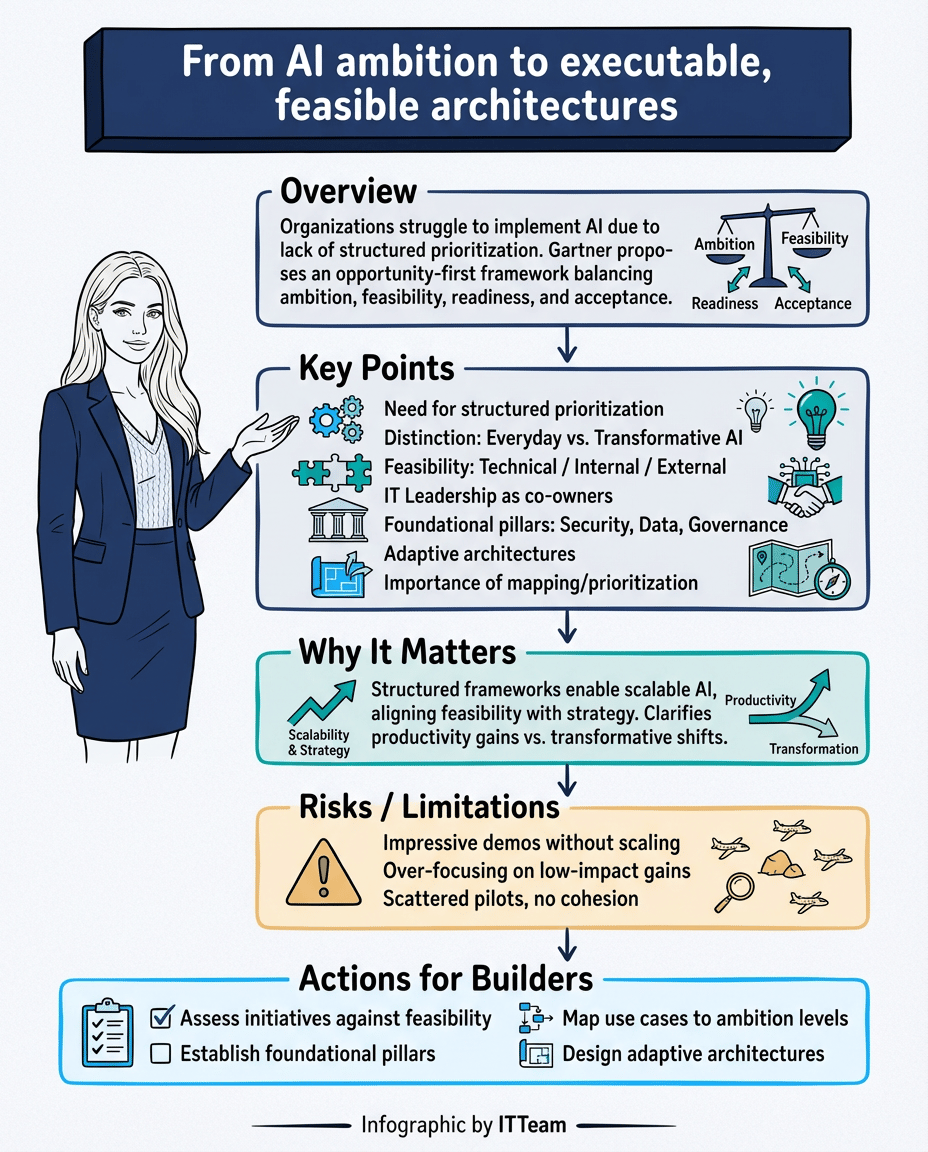
Architecture must align to ambition level — not the other way around. High-feasibility use cases favor lightweight, modular designs. Game-changing use cases require governance, quality gates, and observability from day one. Treating them the same is the most common and most expensive mistake in enterprise AI.
How We Apply This in Practice
Every engagement we take on starts with the same question: what's the actual ambition level here, and have the stakeholders made that explicit and agreed on it?
Then we map the candidate use cases — across opportunity type and feasibility dimensions — before we touch any technical design. This usually surfaces misalignments between what the business wants, what IT believes is technically feasible, and what security will approve for production deployment.
Getting those conversations to happen at the beginning, with a shared framework and explicit criteria, is what prevents the situation most organizations end up in: six months into a pilot, realizing the use case was never viable to begin with, or that the architectural decisions locked in early won't support the scale or governance requirements they actually need.
AI success starts with prioritization. Everything else — the architecture, the tooling, the delivery model — follows from there.