Most AI initiatives fail not because of weak models, but because of fragile system design. The distinction between agentic and monolithic architecture is where enterprise AI either earns its keep — or quietly collapses.
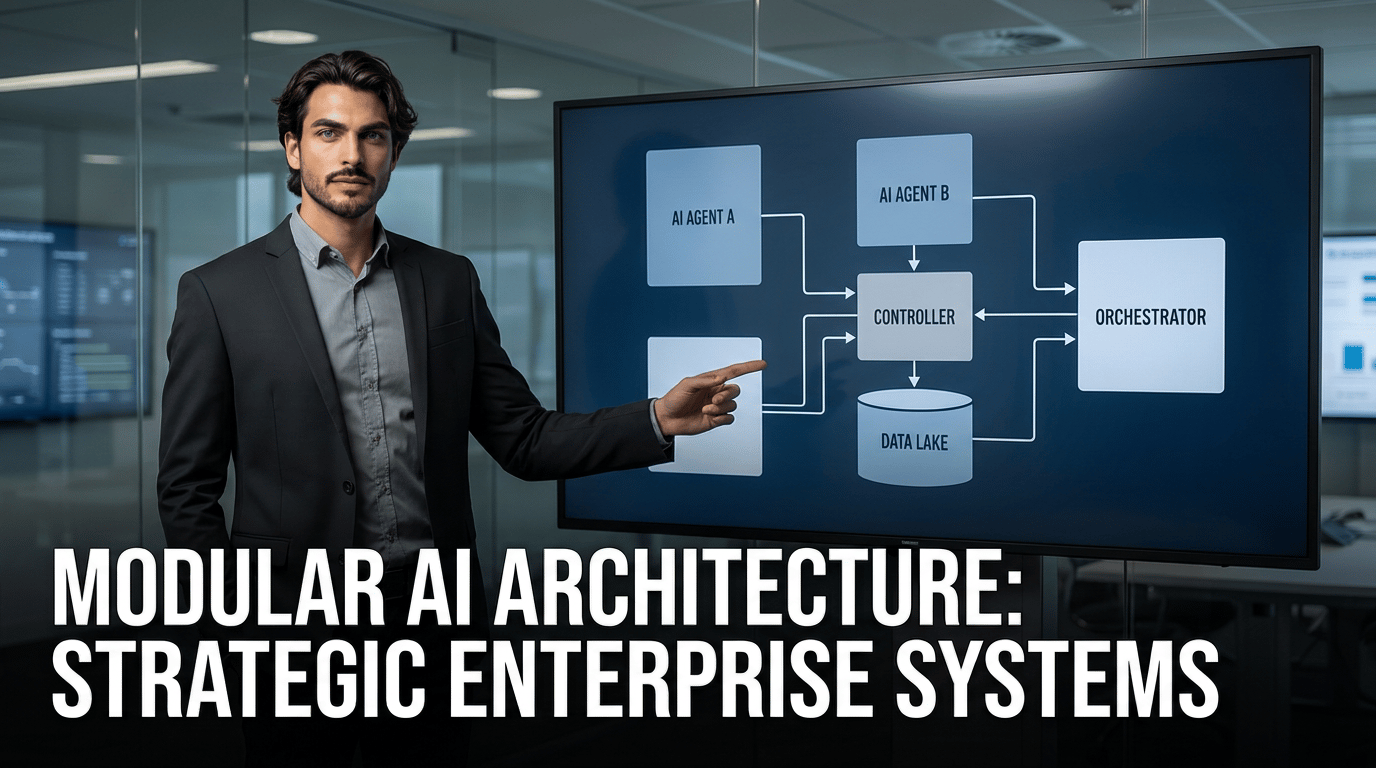
When organizations build AI systems, they almost always start with a monolithic approach: one model, one workflow, one component that handles discovery, reasoning, decision-making, and execution. It's fast to build, easy to demo, and completely reasonable as a starting point. The problem is what happens next.
As scope expands, as governance requirements appear, as the business asks "why did it do that?" — monolithic systems begin to crack. Not because the model is wrong. Because the architecture was never designed to be understood, audited, or changed safely under real-world conditions. The failure is architectural. And it was always coming.
What Monolithic AI Systems Do Well — and Where They Break
Monolithic systems have genuine strengths that explain why so many teams start with them:
- Fast to prototype — a single model or chain can be wired up quickly
- Simple to demo — one component, one output, easy to show
- Minimal orchestration overhead — no coordination layer to design or debug
- Low initial setup cost — fewer moving parts, faster time to first result
For proofs of concept, narrow and well-defined tasks, and early experimentation, these properties make monolithic systems the right choice. The problem arises when organizations push them beyond their natural limits — into production environments where the requirements are different and the stakes are higher.
As scope grows, monolithic systems exhibit predictable failure modes:
- Tight coupling between logic, data, and execution — changing one thing breaks everything else
- Hidden decision-making inside prompts or chains that cannot be audited or explained
- Limited explainability for enterprise stakeholders who need to know why a decision was made
- High blast radius when changes are required — small modifications trigger large refactors
- Poor adaptability to new models or requirements — the system is often tied to a specific vendor or model version
What works in a demo becomes fragile in production. Architecture — not model choice — is the primary determinant of long-term AI success.
Agentic Architectures: A Different Design Philosophy
Agentic architectures treat AI systems as distributed decision systems, not single intelligent units. Rather than asking one component to do everything, responsibility is deliberately distributed across multiple specialized agents — each with a single, well-defined role.
Each agent in a well-designed agentic system:
- Has a single, well-defined responsibility with no hidden scope
- Operates with explicit inputs and outputs — clear contracts between components
- Can be evaluated, replaced, or scaled independently without touching adjacent agents
The system's intelligence emerges from coordination — not from one overloaded component trying to do everything at once. This is a fundamentally different relationship between capability and architecture.
Five Architectural Differences That Define the Gap
1. Responsibility Distribution
In a monolithic system, one component tries to decide what to do and how to do it simultaneously. In an agentic architecture, upstream agents decide what matters and downstream agents decide how to act. This separation dramatically improves clarity, control, and the ability to audit any individual decision in isolation.
2. Scalability and Change Tolerance
Monolithic systems require large refactors for small changes. When logic, data, and execution are tightly coupled, there is no safe way to modify one without risking the others. Agentic architectures allow agents to evolve independently. New capabilities are added at the relevant layer without rewriting the system — enabling incremental scaling instead of periodic rewrites.
3. Explainability and Governance
In monolithic systems, decisions are embedded inside opaque prompt logic. There is no way to trace why a specific output was produced without inspecting the entire chain. In agentic architectures, each decision point is explicit and observable. This makes auditing possible, governance enforceable, and trust sustainable — which are prerequisites for enterprise adoption, not optional features.
4. Model and Vendor Flexibility
Monolithic systems are often tightly bound to a specific model or provider. When that model is deprecated or a better option emerges, the system must be substantially rebuilt. Agentic architectures are model-agnostic by design: models can be swapped, upgraded, or mixed across agents without changing system logic, routing rules, or downstream behavior.
5. Failure Isolation
In a monolithic system, a single failure impacts the entire workflow. There is no containment boundary — everything downstream of the failure is affected. In agentic architectures, failures are isolated within an agent's scope. A discovery agent failure doesn't corrupt the intelligence layer. An execution agent error doesn't roll back scoring state. This reduces operational risk and dramatically simplifies debugging.
When Each Approach Is Appropriate
Agentic architecture is not always necessary. Monolithic systems remain the right choice when scope is narrow and stable, time-to-demo is the primary goal, governance requirements are minimal, and long-term scaling is not expected. The problem arises when monolithic designs are pushed beyond these conditions.
Agentic design becomes essential when:
- Multiple decisions must precede execution
- Prioritization and quality gates are required to protect downstream processes
- Different models or tools are needed at different stages of the workflow
- Governance and explainability are non-negotiable — for compliance, trust, or audit
- The system must evolve over time as requirements, models, and business needs change
At this point, monolithic systems stop being a pragmatic starting point and become architectural liabilities. The cost of maintaining them grows faster than the value they deliver.
Key takeaway
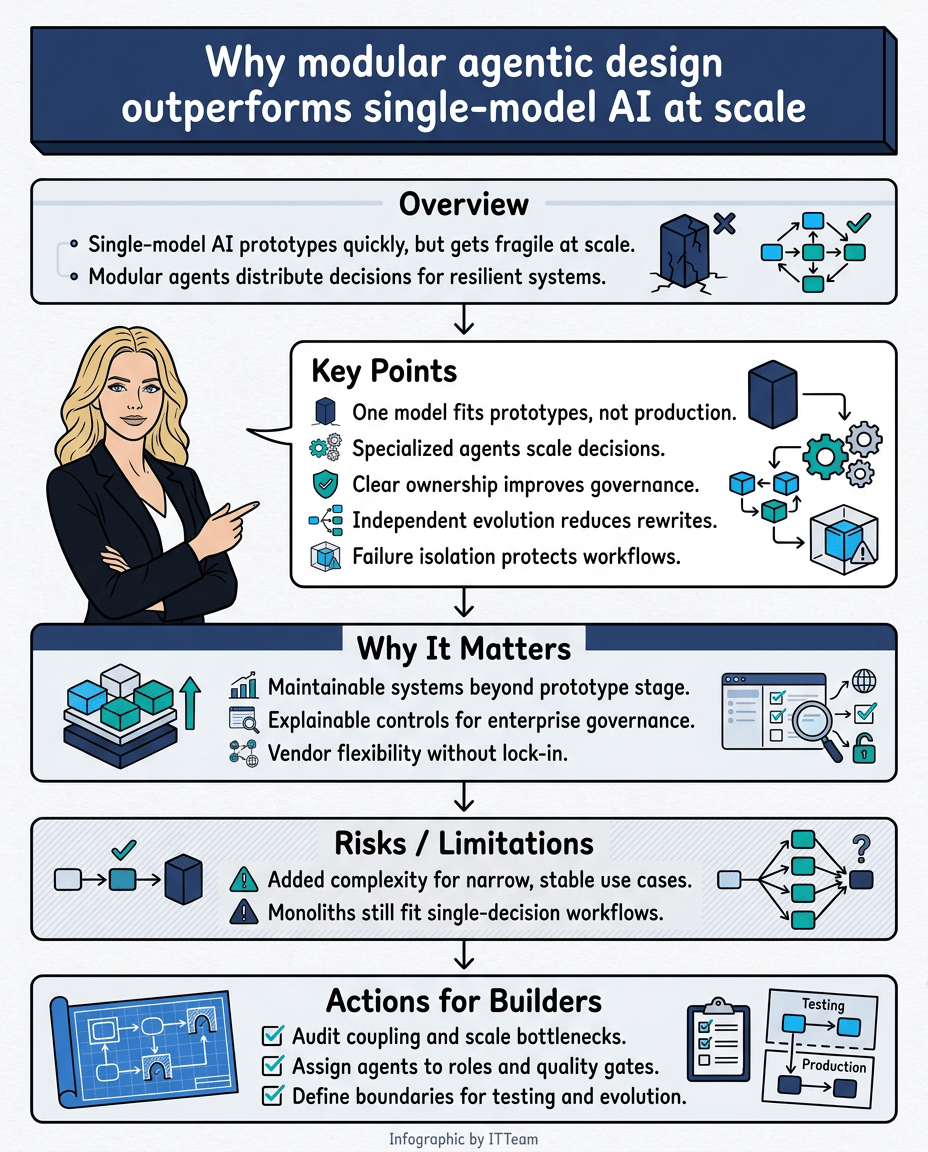
Most AI failures are architectural, not model-related. Monolithic systems optimize for speed to demo, not resilience at scale. Agentic architectures distribute responsibility deliberately — enabling the separation of concerns, failure isolation, and explicit governance that enterprise AI systems require to operate and evolve in production.
How We Apply This in Practice
The question we ask at the start of every engagement is not "which model should we use?" It's "how should responsibility be distributed across this system?" That question determines the architecture — and the architecture determines everything else.
For organizations early in their AI journey, we often start with a clear inventory of what decisions need to be made before any action is taken. That inventory almost always reveals that a monolithic design would force a single component to carry too much — and that separating those decisions into distinct agents produces a system that's not just more governable, but easier to improve over time.
The transition from monolithic to agentic doesn't have to happen all at once. It can be phased — starting with the highest-risk decision points and working outward. What matters is that the architectural intent is established early, before tightly coupled logic becomes too expensive to untangle. That's the difference between designing for production and designing for the demo.