AI has made building a product almost trivially fast. It has done nothing to make finding a customer any easier. That asymmetry is the most under-priced risk in AI product strategy today.
A working prototype used to be proof of something. It meant a team had spent months wrestling with a problem, made hard architectural choices, and shipped. The artifact was expensive, so its existence carried information. Today a competent team can produce a polished, demo-ready AI product in a weekend. The artifact is cheap, so it carries almost no information at all.
What has not become cheap is the thing that was always hard: getting a real organization to change how it works, sign a contract, connect its data, and put your system in the path of decisions that matter. That is still slow, still political, and still the only reliable signal that you have built something worth building.
Speed Is Not Demand
The most common failure pattern we see is not technical. It is a team that has mistaken throughput for traction. They have shipped four products in a quarter, each one technically sound, and none of them attached to a customer who would notice if it disappeared tomorrow.
Building faster only compounds whatever assumption you started with. If the assumption is right, speed is leverage. If it is wrong — and before a customer commits, you have no way of knowing which — speed just gets you to the wrong destination sooner, with more code to maintain and more sunk cost to defend.
A prototype proves you can build it. Only a customer proves it was worth building.
Interest Is Not Validation
This is where most teams deceive themselves, and they do it in good faith. The demo goes well. People lean in. You hear "this is exactly what we need," "send me the deck," "let's explore next steps." It feels like validation. It is not.
Enthusiasm is free. It costs a stakeholder nothing to be excited about your product in a thirty-minute meeting, because nothing in their world has to change for them to say so. The moment something does have to change — a budget line, a security review, a data access request, an integration ticket in someone else's backlog — the enthusiasm meets friction, and you find out what it was actually worth.

There is a practical test. Ask what the next step costs the person saying yes. If the answer is "nothing," you have interest. If it costs them money, political capital, an approval they have to go and get, or a slot on a roadmap they have to defend, you have validation. Only the second kind survives contact with an organization.
What Commitment Actually Looks Like
- A purchase order or signed pilot agreement — even a small one. Money changing hands is the cheapest, fastest way to separate a real buyer from a friendly audience.
- A named internal owner — someone whose results are affected by whether your system works. Without one, the project has no immune system inside the organization.
- Access to real data — not a sanitized sample. Getting production data access approved is a slow, revealing process, and a customer who starts it is telling you something a compliment never will.
- A date they care about — tied to a quarter, an audit, or a launch. Urgency that already exists in their calendar rather than in yours.
Real Use Exposes What Demos Hide
The second reason the first customer outranks the first product is that only real usage surfaces the requirements that determine whether the system can exist at all.
A demo runs on clean inputs, one user, no permissions model, no audit trail, and no failure path. Production runs on none of those things. The constraints that end up defining the architecture almost never appear in the prototype:
- Compliance and data residency. Where the data can live, who can see the prompts, what has to be logged, and how long it is retained. These are architectural decisions rather than settings, and discovering them late means rebuilding.
- Identity and permissions. An AI system that reads across an organization's data has to respect the same access boundaries a person would. This is usually the hardest integration in the project, and it never appears in a demo.
- Integration surface. The CRM, the ticketing system, the data warehouse, the identity provider — each with its own version, its own rate limits, and its own owner who never agreed to your timeline.
- Failure behavior. What happens when the model is confidently wrong at 3am, who gets notified, and what the system does while it waits for a human. Demos have no answer because demos have no 3am.
- Unit economics at volume. A workflow that costs pennies across ten runs may be unaffordable across ten thousand. The first customer is where you learn whether the business model survives its own success.
Every one of these is discovered rather than designed. A committed customer is the instrument that discovers them, and it is far cheaper to find them during one real deployment than across five speculative products at once.
One Urgent Problem Beats Ten Interesting Ones
There is a strong temptation, once you have a capable AI stack, to build broadly. The technology genuinely does generalize, so building a platform feels efficient. In practice it produces something that is plausible everywhere and indispensable nowhere.
Solving one urgent problem completely for one customer does more for the eventual platform than solving ten partially. You end up with working integrations, a real evaluation set, quality gates calibrated against actual failure modes, and a reference customer who can describe the value in their own words. Those are the assets that generalize. A broad feature surface is not.
The pattern that becomes a product is one you extract from a deployment that already works, not one you guess at in advance. First customer, then pattern, then product — in that order.
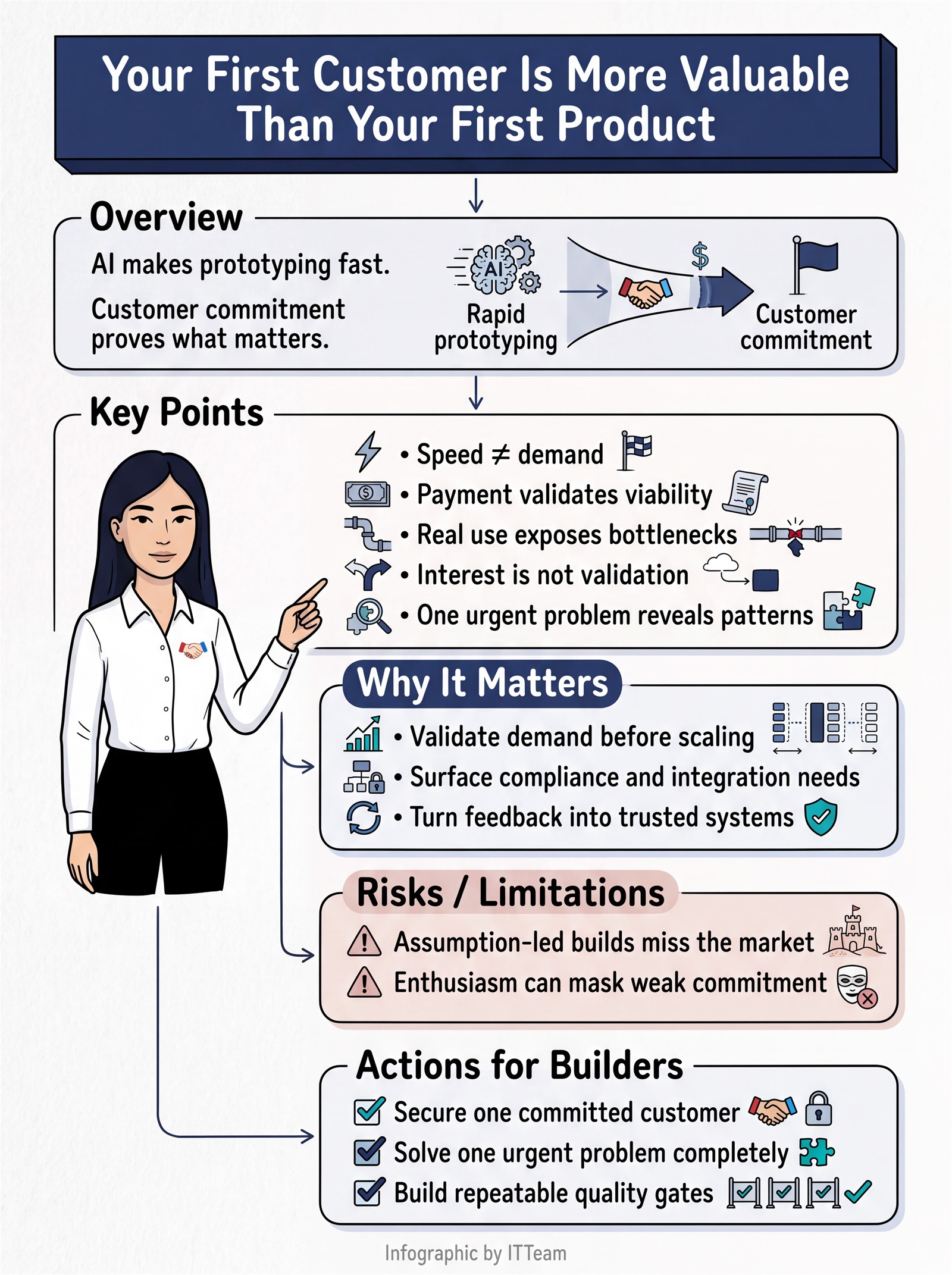
Key takeaway
AI has removed the cost of building, which means a working product is no longer evidence of anything. The first customer who commits budget, data access, and a named owner is now the cheapest validation available — and the only one that tells you what to build next.
How We Apply This in Practice
When we engage on a new AI initiative, the first question is not what the system should do. It is who has already agreed to use it, and what that agreement costs them. If the answer is thin, the right first deliverable is not an architecture — it is the work required to secure one committed customer with one urgent, well-defined problem.
From there the sequence is deliberate. We solve that problem end to end, including the unglamorous parts: identity, data access, evaluation, human oversight, and the quality gates that decide when the system may act on its own. Those gates are built once against real failure modes and reused for everything that follows.
Only then do we generalize. The patterns worth turning into a platform are the ones already surviving in production for someone who pays for them. That order is slower to start and considerably faster to arrive, because nothing built along the way has to be thrown out when the market answers back.