Most organizations are trapped in an expensive and fragile AI tooling model — managing multiple subscriptions, integrations, and vendors. Consolidating AI capabilities into a single, model-agnostic platform is no longer a cost-saving tactic. It is a strategic necessity.
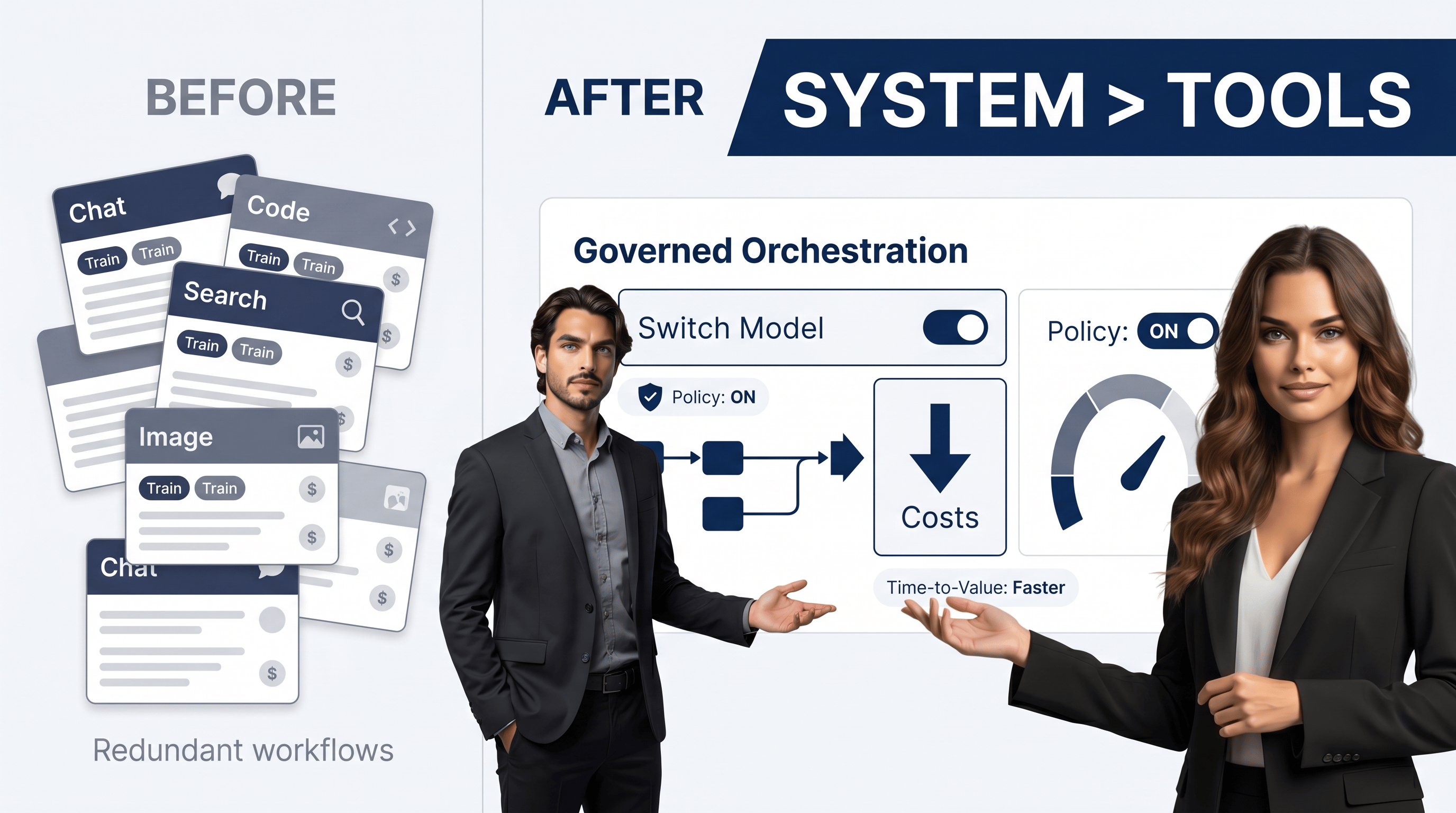
The Problem Is Not Tool Choice — It Is Tool Sprawl
The enterprise AI landscape has changed dramatically. AI models evolve monthly, new capabilities emerge constantly, and no single model excels at every task. Yet many organizations still follow an outdated approach: buying and managing multiple AI tools — each optimized for a narrow use case — resulting in fragmented workflows, rising costs, and growing operational complexity.
Organizations today face a compounding set of pressures:
- Rising AI subscription costs — separate contracts, renewals, and vendor relationships for each tool
- Fragmented user experiences — teams context-switching between disconnected interfaces
- Duplicate training and onboarding — every new tool requires its own enablement effort
- Complex integration and orchestration — bespoke connectors that break whenever a vendor updates their API
As AI usage expands across teams, this complexity compounds. What starts as experimentation quickly becomes an operational burden that slows innovation instead of accelerating it. The result: higher spend, slower execution, and lower ROI.
Core Principles of a Smarter AI Strategy
1. There Is No "Best" AI Model — Only the Best Model per Task
Every AI model excels at something different: search, reasoning, coding, creativity, video and voice generation. And the landscape changes continuously. New models outperform old ones, benchmarks shift, and capabilities evolve faster than procurement cycles.
A strategy built around fixed tools is structurally outdated before it is even deployed.
2. The Multi-Tool Subscription Model Is Fundamentally Broken
Trying to "buy everything" leads to staggering costs:
- $250–$400 per user, per month in subscriptions
- $3K–$5K per user, per year
- $30K–$50K annually for a small team — before integration and support costs
And that still does not include automation platforms, presentation tools, data enrichment services, or industry-specific AI solutions. The financial and operational overhead grows faster than the value delivered.
3. Strategic Agility Beats Tool Ownership
A smarter approach flips the model entirely:
- One platform — a single operational surface across the organization
- One subscription — unified commercial relationship and renewal cycle
- Unified interface and governance — consistent user experience and control layer
- Access to a broad catalog of AI models — best-in-class capability for each task type
- Instant model switching per task — adapt as the landscape evolves, without re-architecture
When a better model appears, you do not migrate systems or renegotiate contracts — you simply switch the agent's model. This is not just about saving money. It is about remaining adaptable in a market that changes faster than IT planning cycles.
The organizations that win at AI will not be those with the most tools. They will be those with the most adaptable infrastructure.
4. ROI Comes from Consolidation, Not Accumulation
A unified AI platform enables centralized orchestration, consistent governance and security, reduced integration complexity, and faster time-to-value. In real terms, this can translate into:
- Up to ~96% reduction in AI tooling costs
- Elimination of most integration overhead
- Faster deployment of AI agents — hours instead of months
The value is operational, not theoretical. Consolidation removes the friction that prevents organizations from deploying AI at scale.
5. Future-Proofing Is a Design Requirement, Not a Bonus
Enterprise AI strategies must assume continuous model evolution, vendor volatility, and shifting performance benchmarks. A platform that avoids model and vendor lock-in:
- Reduces technical debt — no stranded investments when a vendor pivots or a model is deprecated
- Preserves strategic flexibility — the ability to adopt new capabilities without re-architecture
- Allows organizations to move at the speed of AI — not at the speed of procurement
Future-proofing is no longer optional — it is a baseline requirement for any enterprise AI strategy built to last.
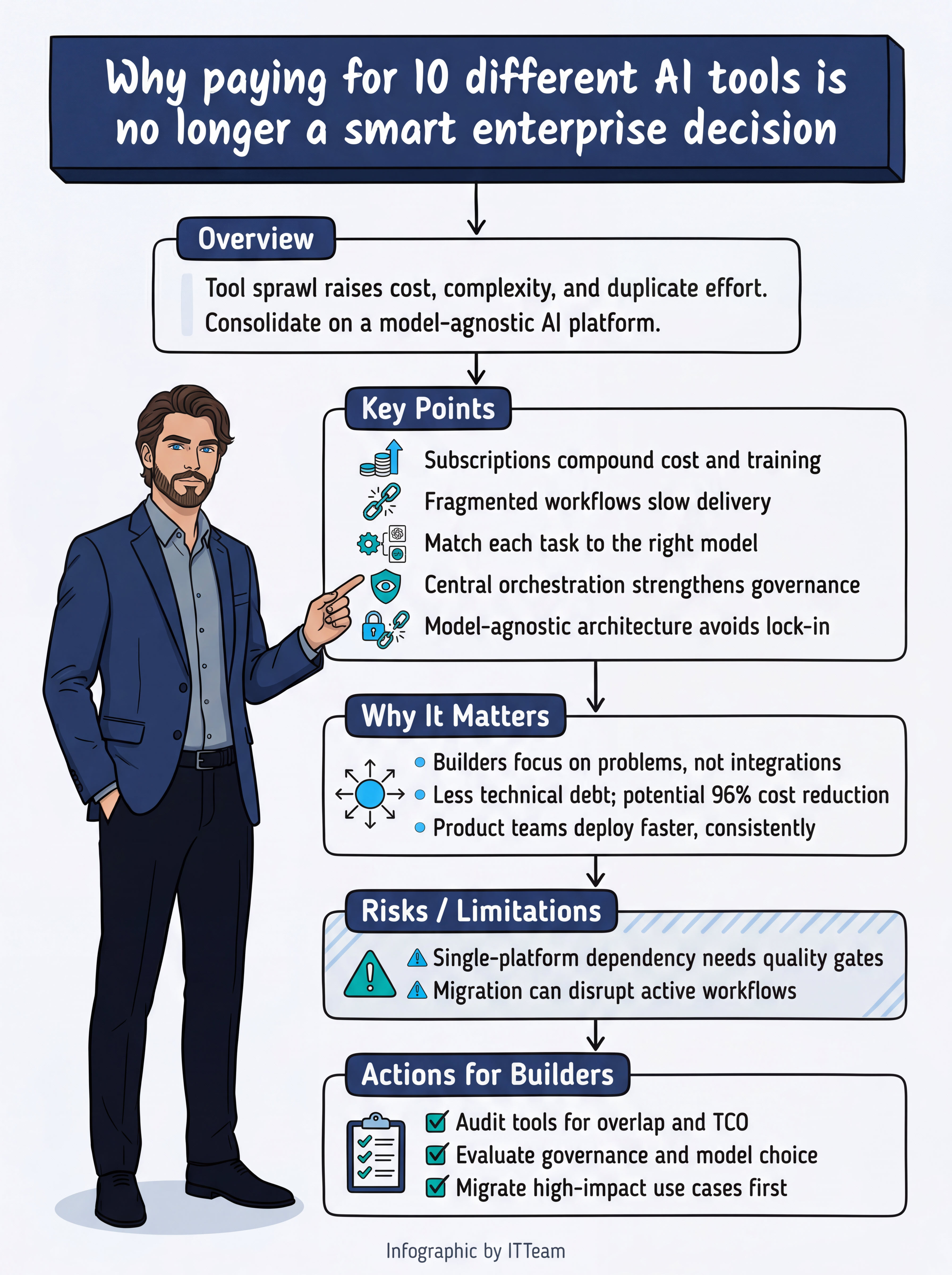
Key takeaway
The question is not which AI tools to buy — it is how to stop buying tools and start building a platform. Consolidation is the strategic move that turns AI spend from a liability into a competitive advantage.
How We Apply This in Practice
When we help organizations design their AI strategy, the first audit we run is not a capability assessment — it is a subscription audit. In almost every case, we find significant overlap, redundancy, and tools that are barely used.
From there, we map the organization's actual AI task types against a multi-model platform architecture: which models handle which workloads, how orchestration is centralized, and how governance is applied consistently across all AI activity.
The outcome is a leaner, more agile AI estate — one that costs less, governs better, and adapts faster. Not because we found better tools, but because we stopped accumulating them.