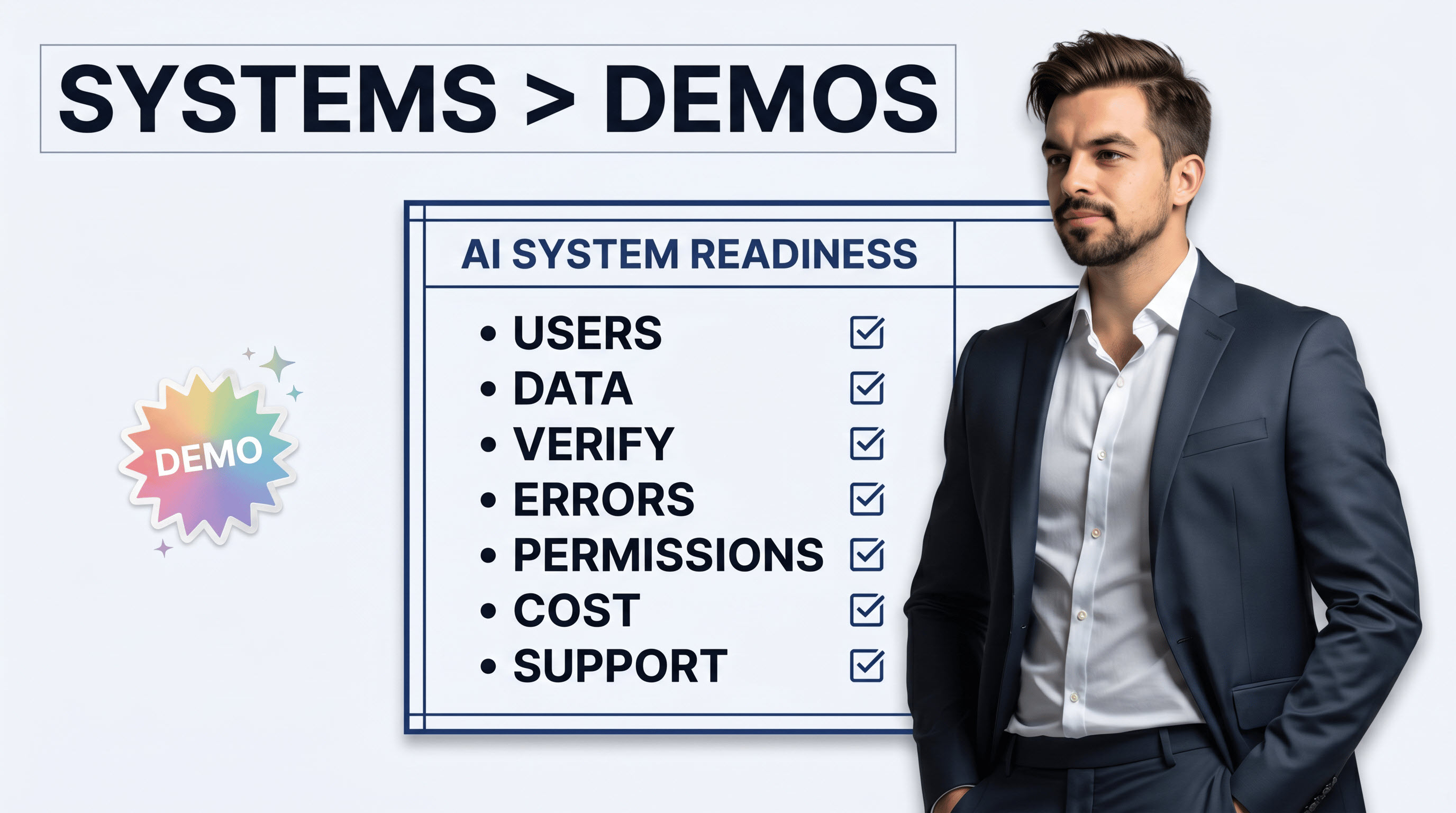
There is a big difference between an AI toy that looks impressive in a demo and an AI system that actually works inside an organization. The gap between the two is where most AI projects quietly fail.
We Have Seen This Movie Before
The technology world is full of products that looked like the future — until reality entered the room.
- Theranos — promised a revolution in blood testing from a single drop of blood. It reached a valuation of around $9 billion, but the technology did not deliver what was promised.
- Juicero — sold an expensive smart juicer, until people realized you could squeeze the juice packs by hand almost as effectively.
- Google Glass — looked like the future of wearable computing, but the price, privacy concerns, and unclear everyday use case limited adoption.
- Humane AI Pin — introduced as an AI device that could replace the smartphone, but the product was eventually discontinued after the company was acquired by HP.
The problem in all these cases was not only the technology. The real problem was the gap between promise, real need, infrastructure, and the ability to work over time.
And this is exactly what is happening today with many AI projects.
An AI Toy Looks Good. An AI System Works Well.
An AI toy is something that impresses you the first time you see it. It summarizes text. Creates an image. Writes an email. Builds a screen. Returns a nice answer. And yes, that can be useful.
But a real AI system needs to answer much less glamorous questions:
- Who is the user?
- What problem are we actually solving?
- Where does the data come from?
- How do we verify the output?
- What happens when the model is wrong?
- Who gets notified?
- How do we protect permissions?
- What happens to the cost when we move from 10 runs to 10,000?
- Who supports it when something breaks?
Because inside a real organization, "it worked in the demo" is not an operational standard. That is like saying: "The car drives nicely downhill, so it is probably ready for a mountain expedition."
Before Building an Agent, Understand the Problem
Many people start with the wrong question: "What AI Agent can we build?"
The better question is:
What business process is painful enough to justify an Agent?
AI should not be digital decoration. It should improve a process, save time, reduce errors, accelerate decisions, or create a capability that did not exist before.
Without a clear problem, there is no real system — only a nice experiment. And experiments are important, but we should not confuse experiments with business solutions.
Three Things to Check Before Building
1. Security and Governance
AI that touches business data must be built with clear boundaries.
- Who is allowed to see what?
- Which data should never be sent to a model?
- How are actions logged?
- How do we prevent exposure of sensitive information?
- What happens if the user asks the system to do something it should not do?
Without this, an Agent can quickly become a smart new employee who talks too much near the coffee machine.
2. Platform and Support
Not every platform that works for a demo is suitable for an organization. You need to check: Is the API stable? Are permissions manageable? Can it connect to existing systems? Are there logs? Is there real support? Can the system be maintained and improved over time?
Because once a system enters a business process, the question is not only "Does it work right now?" The real question is: Who is responsible when it stops working on Wednesday at 8:30 AM, right before the leadership meeting?
3. Cost and Model Strategy
Many people choose an AI model by brand name — OpenAI, Claude, Gemini, the new model everyone is talking about this week. But good architecture does not choose a model based on hype. It chooses a model based on the task.
- Sometimes you need the strongest model.
- Sometimes a faster and cheaper model is enough.
- Sometimes you need RAG.
- Sometimes you need a workflow.
- Sometimes you do not need AI at all — just simple automation.
The smart move is not to use the most expensive model. The smart move is to build a system that delivers the right outcome, at the right cost, with the right level of reliability for the business.
The Market Changes Fast. That Is Why Architecture Matters More Than the Tool.
Today, everyone is talking about one tool. Tomorrow, everyone moves to another. Next week, a new model comes out, and LinkedIn looks like humanity discovered fire for the seventh time.
And that is fine. This is progress. But because the market is changing so quickly, you should not build your organization around one tool only. You should build around principles:
- A clear problem
- A clear process
- Reliable data
- Permissions
- Measurement
- Controls
- The ability to switch models
- Maintainability
- Scalability
Tools will change. Good architecture lasts.
The Demo Is Not the Product
A good demo can open the door. But it does not prove that the system is ready for real work.
- The demo shows potential. The system must prove stability.
- The demo answers one question. The system must handle edge cases.
- The demo works with clean data. The system must deal with real data — messy, incomplete, duplicated, and sometimes formatted like someone copied it from Excel during an earthquake.
The demo is impressive. The system holds. That is the difference.
So How Should We Build AI Properly?
Start small, but think systemically.
You do not need a monster project or a committee of 14 people. But you do need order:
- Define one business problem.
- Map the current process.
- Understand where AI actually adds value.
- Define the data sources.
- Define permissions and controls.
- Build the first version.
- Measure the result.
- Improve it.
- Only then, scale it.
It may be less exciting than a video called "I built a startup in 8 minutes." But it works.
Key takeaway
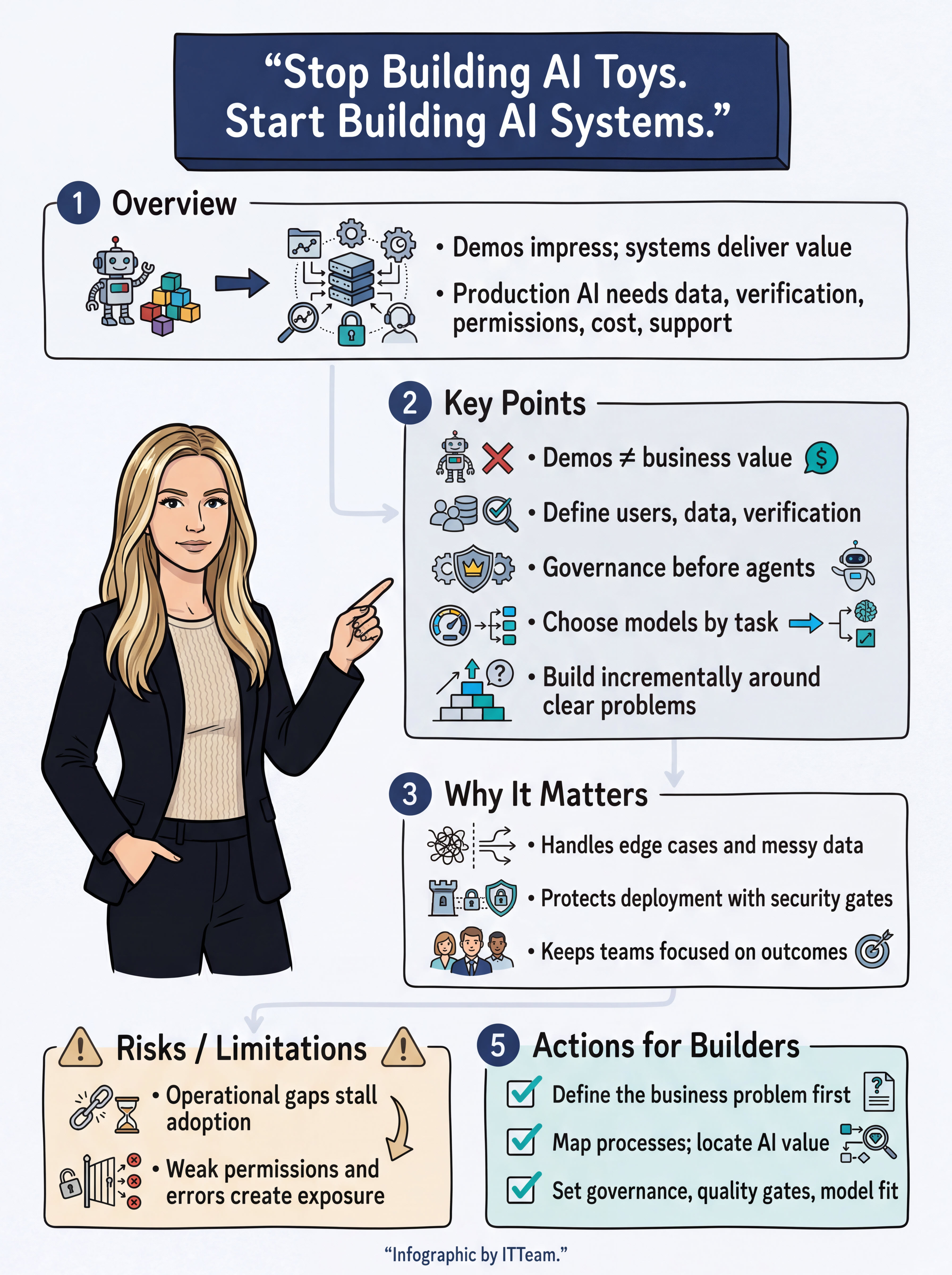
AI is not magic — it is a capability. Its value depends entirely on how well it is integrated into a real system. Before building your next Agent, stop and ask: Am I building something that looks smart, or something that actually works?
How We Apply This in Practice
Every engagement we run starts with the same discipline: define the business problem first, then design the system around it. We map data sources, establish governance boundaries, select the right model tier for each task, and build measurement into the architecture from day one — not as an afterthought.
The goal is never to impress in a demo. The goal is a system that is still running, still delivering value, and still maintainable six months after the first deployment.