Human oversight is essential for trustworthy AI — but when applied indiscriminately, it destroys the scale and speed that make AI worth deploying in the first place.
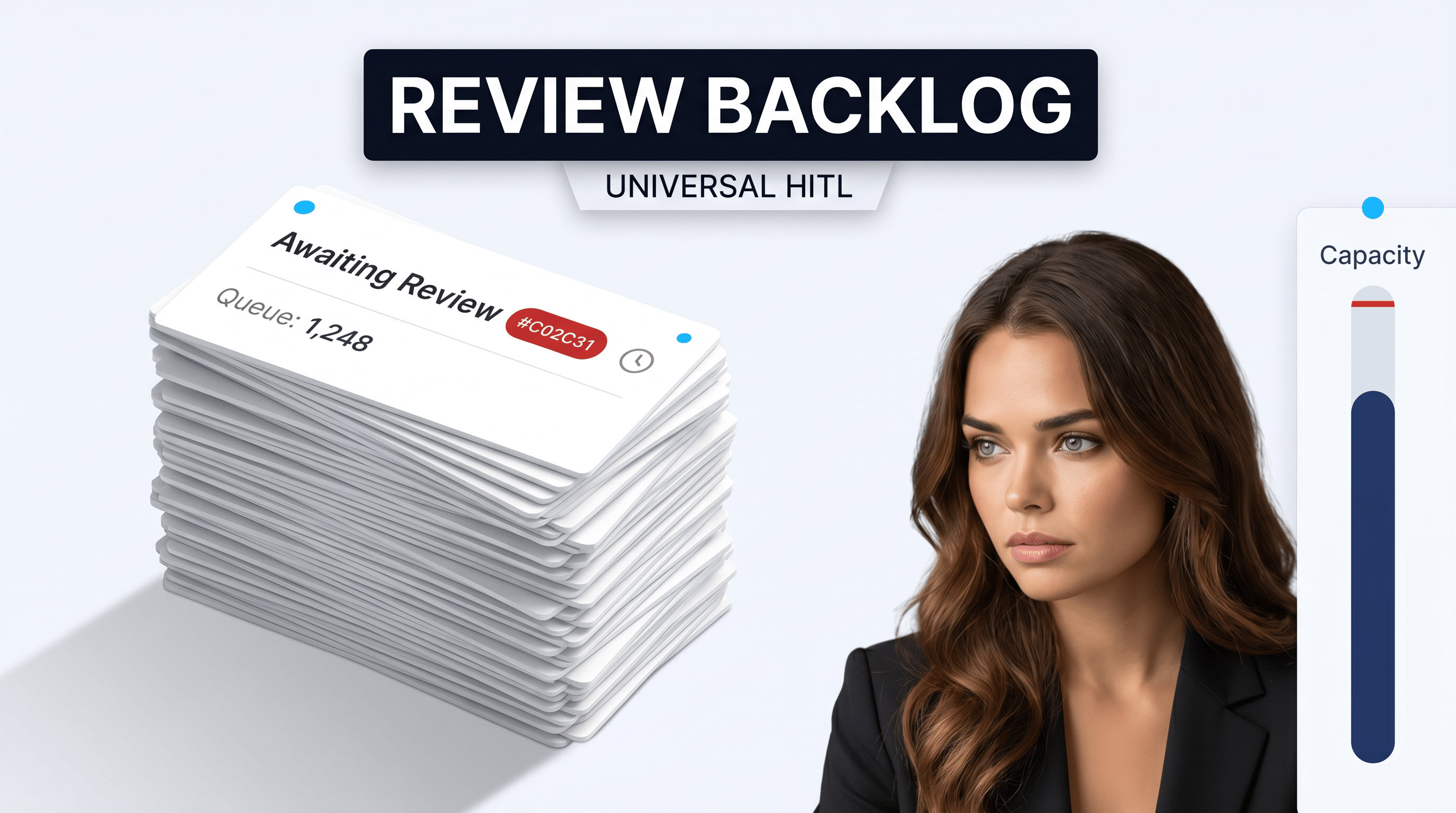
Why "Human-in-the-Loop Everywhere" Fails
When organizations first encounter AI risk, the instinct is to insert humans everywhere. It feels responsible. It feels safe. In practice, it creates a different kind of failure.
When human review is the default rather than the exception:
- Backlogs grow — review queues expand faster than capacity
- Decisions slow down — latency compounds across every touchpoint
- Review quality degrades — volume erodes attention and judgment
- Humans become rubber stamps — approving without truly evaluating
- Automation benefits disappear — the system costs more than it saves
Human-in-the-loop becomes a liability when it is used as a substitute for architecture. Oversight that is not designed is not oversight — it is theater.
The Core Principle: Humans Are Not Safety Nets
In well-designed AI systems, the human role is not to catch everything that might go wrong. It is to apply judgment where judgment genuinely changes the outcome.
That means humans function as:
- Decision amplifiers — not catch-all reviewers
- Escalation points — not default processors
- Context providers — not constant validators
Human oversight must be selective, intentional, and measurable. If it is none of those things, it is simply overhead.
When Humans Should Be in the Loop
Human involvement adds real value when at least one of three conditions is true.
1. Impact Is High
Decisions that affect customers directly, carry reputational risk, or influence financial outcomes warrant human attention. These are the moments where a wrong call has consequences that ripple outward — and where human judgment justifies the cost.
2. Uncertainty Is High
When confidence is low, signals conflict, or context is incomplete, the AI system should not resolve ambiguity on its own. Escalation is not a failure — it is the correct behavior. The system is admitting what it does not know, and routing accordingly.
3. Learning Value Exists
Some cases are worth human attention not because the stakes are high, but because the decision improves the system. Edge cases that refine thresholds, clarify rules, or improve future model behavior are worth routing to humans — once. After that, the system should handle them automatically.
Humans should be where they change the system, not just approve outputs.
Designing Targeted Human-in-the-Loop Mechanisms
Knowing when to involve humans is not enough. The mechanism itself must be designed so that human involvement is efficient, scoped, and consequential.
1. Trigger Humans via Metrics — Not Intuition
Human review should be activated by observable system signals: threshold breaches, confidence gaps, anomaly detection. If a human is reviewing something, the system should be able to explain why — not because someone decided "this feels risky," but because a measurable condition was met.
2. Limit Human Scope Intentionally
Humans should answer specific, bounded questions:
- "Is this output acceptable to proceed?"
- "Which of these options is appropriate?"
- "Should this case be deferred or escalated?"
Open-ended review requests waste cognitive effort and produce inconsistent outputs. The more specific the question, the faster and more reliable the human response.
3. Preserve Context, Not Volume
Human review should surface relevant inputs and prior decisions, the reason the system is uncertain, and what action the review will influence. Context reduces review time and improves decision quality. Presenting raw data without framing forces humans to reconstruct understanding that the system already has — that is wasted effort.
4. Close the Feedback Loop
Every human decision should update something: thresholds, rules, prompts, or models. If human input does not change future behavior, it is wasted effort. The value of human review is not in the individual decision — it is in what the system learns from it.
Human-in-the-Loop as an Architectural Layer
In mature AI systems, human involvement is treated as a layer — not an exception patched on top of the system after deployment.
This layer:
- Has clear entry criteria — defined by metrics, not intuition
- Has defined outputs — specific decisions, not open review
- Is instrumented and measured — escalation rate, resolution time, outcome impact
- Is capacity-aware — designed around realistic human bandwidth
Humans are part of the system. Designing for them is not optional — it is what makes the system trustworthy at scale.
Measuring Human-in-the-Loop Effectiveness
Human oversight should be evaluated like any other system component. Key signals include:
- Escalation rate — what share of outputs reach human review
- Resolution time — how long human decisions take
- Decision consistency — whether similar cases receive similar outcomes
- Impact on downstream outcomes — whether human decisions improve results
- Reduction in repeat escalations — whether the system learns over time
If human load increases without improving outcomes, the design is wrong. That is a signal to redesign escalation criteria — not to add more reviewers.
Common Anti-Patterns
Most failures in human-in-the-loop design follow recognizable patterns:
- "Review everything just in case" — volume without criteria
- Humans compensating for missing logic — oversight used to paper over gaps in the AI layer
- Escalation without clear criteria — reviewers cannot act decisively because the question is not defined
- Reviews with no feedback integration — human judgment is applied but never used to improve the system
- Treating humans as validators instead of decision-makers — approval becomes automatic rather than thoughtful
These patterns destroy both trust and scale. They are not conservative — they are expensive and fragile.
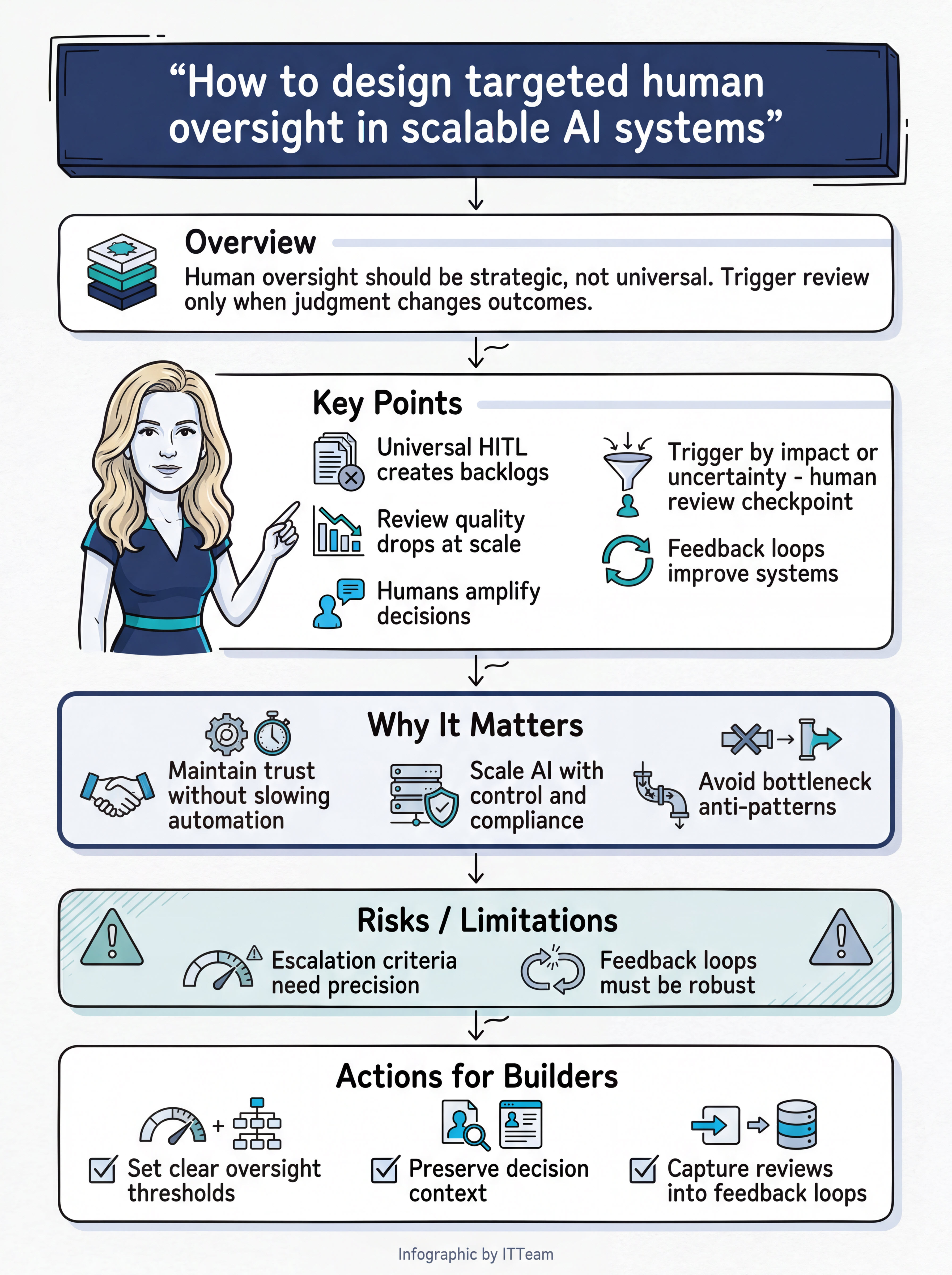
Key takeaway
Poorly designed human-in-the-loop kills scalability. Well-designed human-in-the-loop enables trust at scale — because humans enter only when it matters, act on clear questions, and improve the system every time they do.
How We Apply This in Practice
When we design AI systems for enterprise clients, human oversight is specified before the first automation layer is built — not added afterward to manage risk. We define entry criteria, scope the decision, instrument the escalation path, and wire human feedback back into the system.
The result is not a system where humans review less. It is a system where every human review counts.