IT budgets are flat, headcount growth has stalled, and the demand for transformation has never been higher. CIOs who cannot close that gap in 2026 risk becoming cost centers — those who do will redefine IT as a strategic growth engine.
A New Reality for Enterprise IT Leadership
By 2026, enterprise IT leadership is operating under a fundamentally different set of constraints. Growth expectations are lower, IT budgets are growing only marginally, and headcount growth has nearly stalled. Yet the demand for transformation has not slowed — it has intensified.
The result is a fundamental tension: deliver more impact with fewer resources. The traditional CIO playbook — incremental modernization, multi-year platform rollouts, annual planning cycles — no longer works in this environment.
Core Principles of the 2026 CIO Agenda
1. Efficiency Is the New Growth Strategy
Cost reduction, productivity improvement, and resilience are no longer competing priorities — they must be achieved simultaneously. Organizations that win in this environment are those that:
- Optimize technology spend aggressively — eliminating redundancy before adding capability
- Extract more value from existing platforms — depth before breadth
- Build systems that adapt quickly to disruption — architecture decisions that reduce the cost of change
Doing more with less is no longer a mandate — it is the only viable path forward.
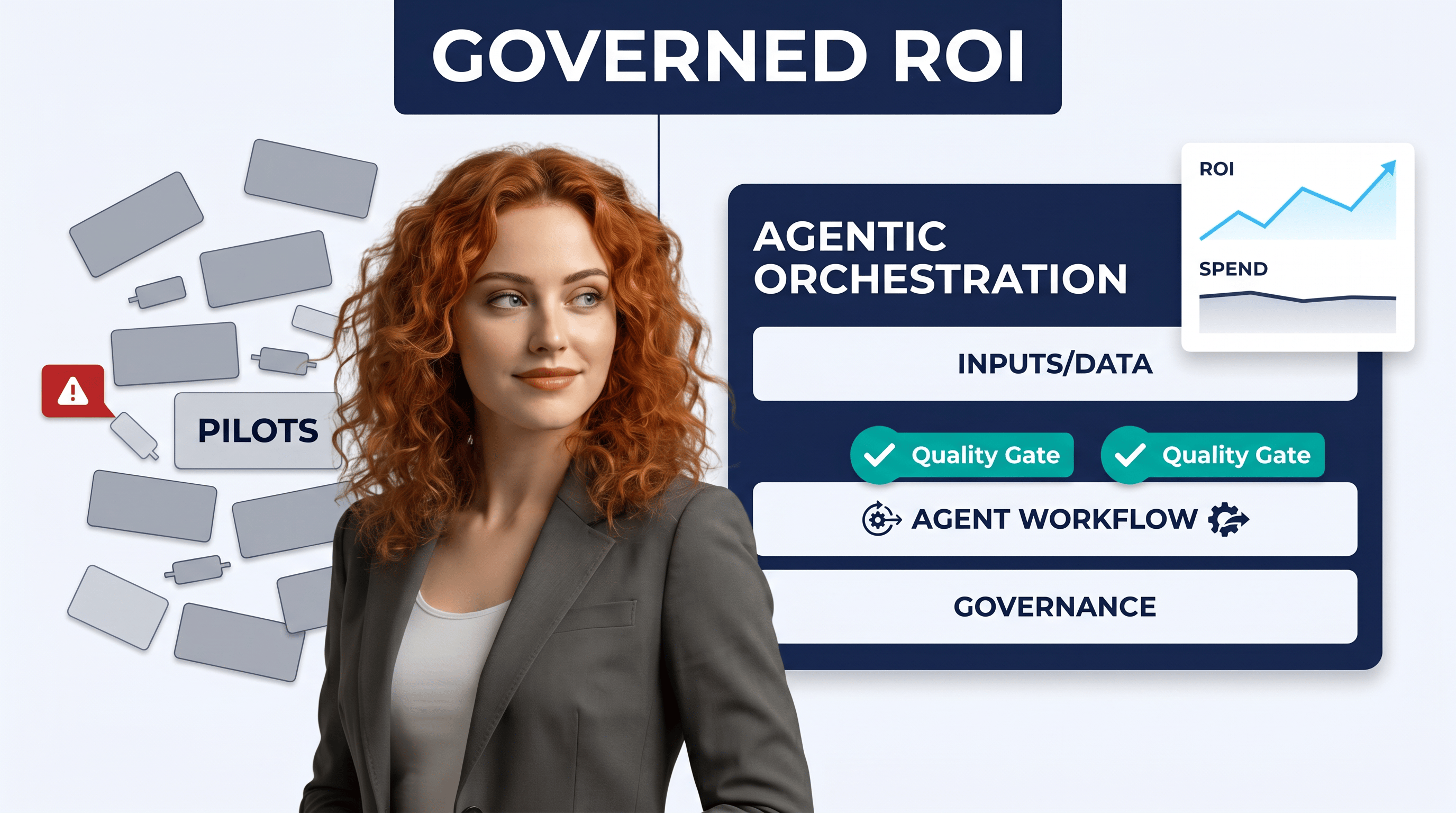
2. From Defending AI Pilots to Delivering Agentic AI ROI
The experimentation phase is over. Leadership now demands clear value targets, measurable ROI, and production-grade AI systems — not more pilots.
Agentic AI represents the critical shift: from tools that assist humans to systems that act autonomously within defined business boundaries. These are not chatbots. They are agents that execute workflows, make decisions, and directly impact revenue, cost, and customer experience. The question is no longer "can we build it?" — it is "can we govern it and measure its value?"
Agentic AI is not the next generation of chatbots. It is the first generation of autonomous business execution — and it demands a completely different governance posture.
3. From Calendar-Based to Trigger-Based Decision Making
Annual planning cycles are relics of a more stable era. Modern CIOs must establish continuous sensing mechanisms and trigger-based responses to market, operational, or technological change. The ability to pivot quickly — without restarting long planning cycles — becomes a core leadership capability, not a side effect.
This requires instrumenting the organization differently: real-time dashboards over quarterly reviews, modular architectures over monolithic rollouts, and pre-approved response playbooks over ad-hoc escalation.
4. Agentic AI Requires New Organizational Readiness
Deploying Agentic AI is not only a technical challenge — it is an organizational one. Technology readiness alone is insufficient. Successful CIOs build three foundations before deployment:
- Clear value definitions — what specific outcomes does this agent need to produce, and how will they be measured?
- Workforce upskilling — turning teams into AI orchestrators who direct, evaluate, and improve agent performance
- Strong data governance — ensuring the trust, quality, and compliance of the data that agents act on
Without these foundations, autonomy becomes risk rather than advantage.
5. AI Investment Continues — but Only for Measurable Impact
Even as overall IT budgets face pressure, AI investment continues to grow. What gets funded in 2026 is specific:
- AI and machine learning with near-term business impact
- Intelligent automation that directly improves productivity
- Analytics and decision intelligence that reduces operational latency
- Cybersecurity and risk management — non-negotiable in an agentic world
The signal is clear: initiatives without measurable outcomes will not survive funding scrutiny.
6. Governance Becomes a Competitive Differentiator
As AI systems gain autonomy, governance can no longer be an afterthought. Leading CIOs establish frameworks that balance innovation velocity with safety, ensure transparency and explainability, and maintain regulatory and ethical compliance.
In 2026, AI governance is not a blocker — it is a strategic advantage. Organizations that can demonstrate trusted, auditable AI execution will move faster, not slower, because stakeholder confidence enables broader deployment.
Key takeaway
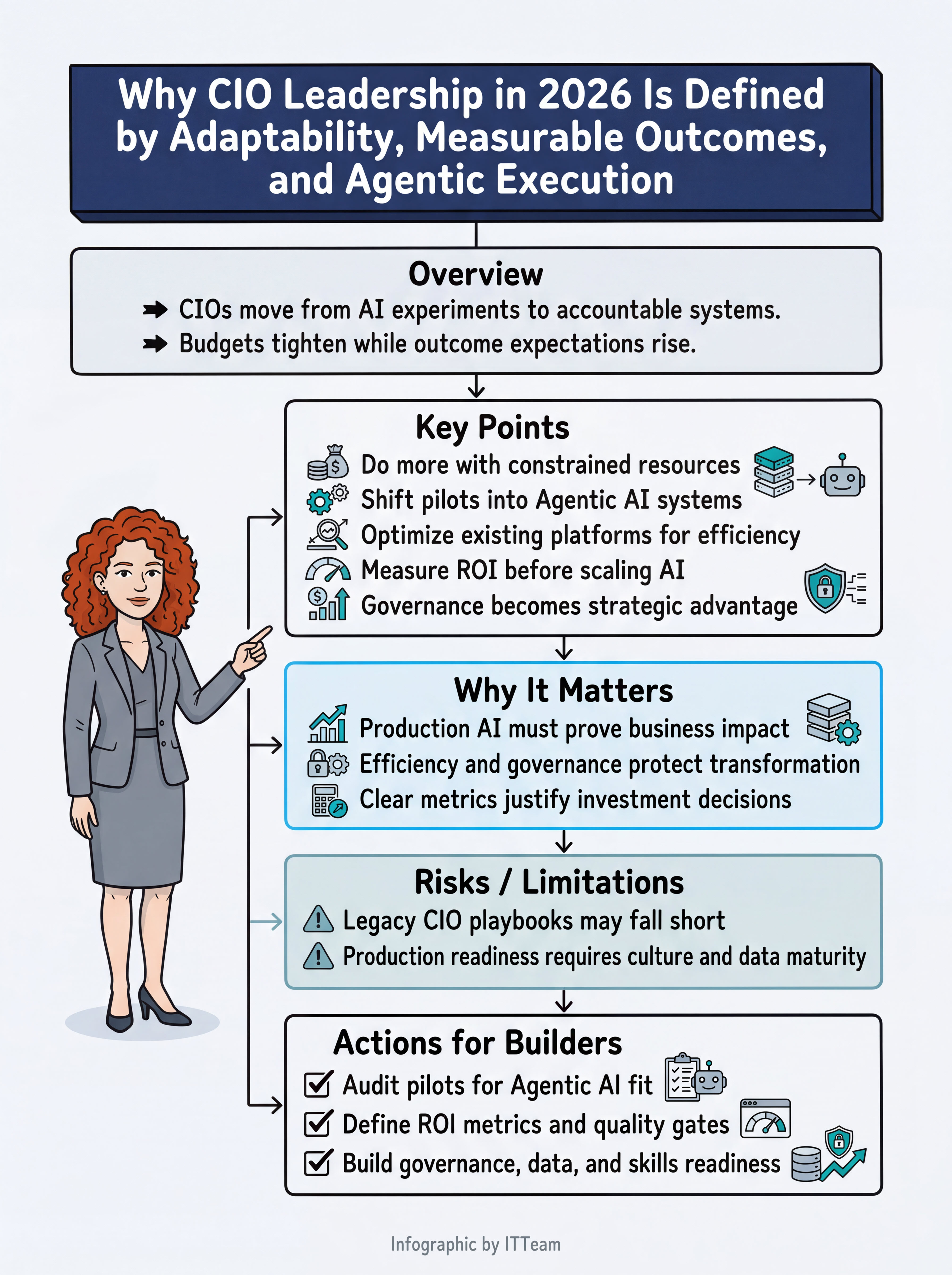
The 2026 CIO agenda is not about adopting more AI — it is about converting AI experimentation into measurable, governed, production-grade execution. Efficiency, adaptability, and trust are the new metrics of IT leadership.
How We Apply This in Practice
When we work with IT leadership teams, the first question we ask is not "what AI tools are you using?" — it is "what outcomes are you accountable for, and which of those can an agentic system directly impact?"
From there, we help map the gap between current GenAI experimentation and production-grade agentic deployment: the governance gaps, the data readiness gaps, and the organizational readiness gaps that prevent pilots from becoming platforms.
The CIOs who will define 2026 are not those with the most AI initiatives — they are those who can point to specific, measurable outcomes that AI delivered. That is the only bar that matters.