Everyone is learning how to prompt AI. Far fewer people are learning how to think with it — and that difference is what separates operating an AI tool from working effectively with one.
We are surrounded by tutorials promising better prompts, smarter workflows, and more powerful AI agents. People are learning how to generate presentations in seconds, write marketing campaigns, analyse documents, and automate entire business processes.
And yet we are spending a great deal of time teaching people what AI can do, and very little teaching them how to decide what AI should do. That gap has a name: AI fluency.
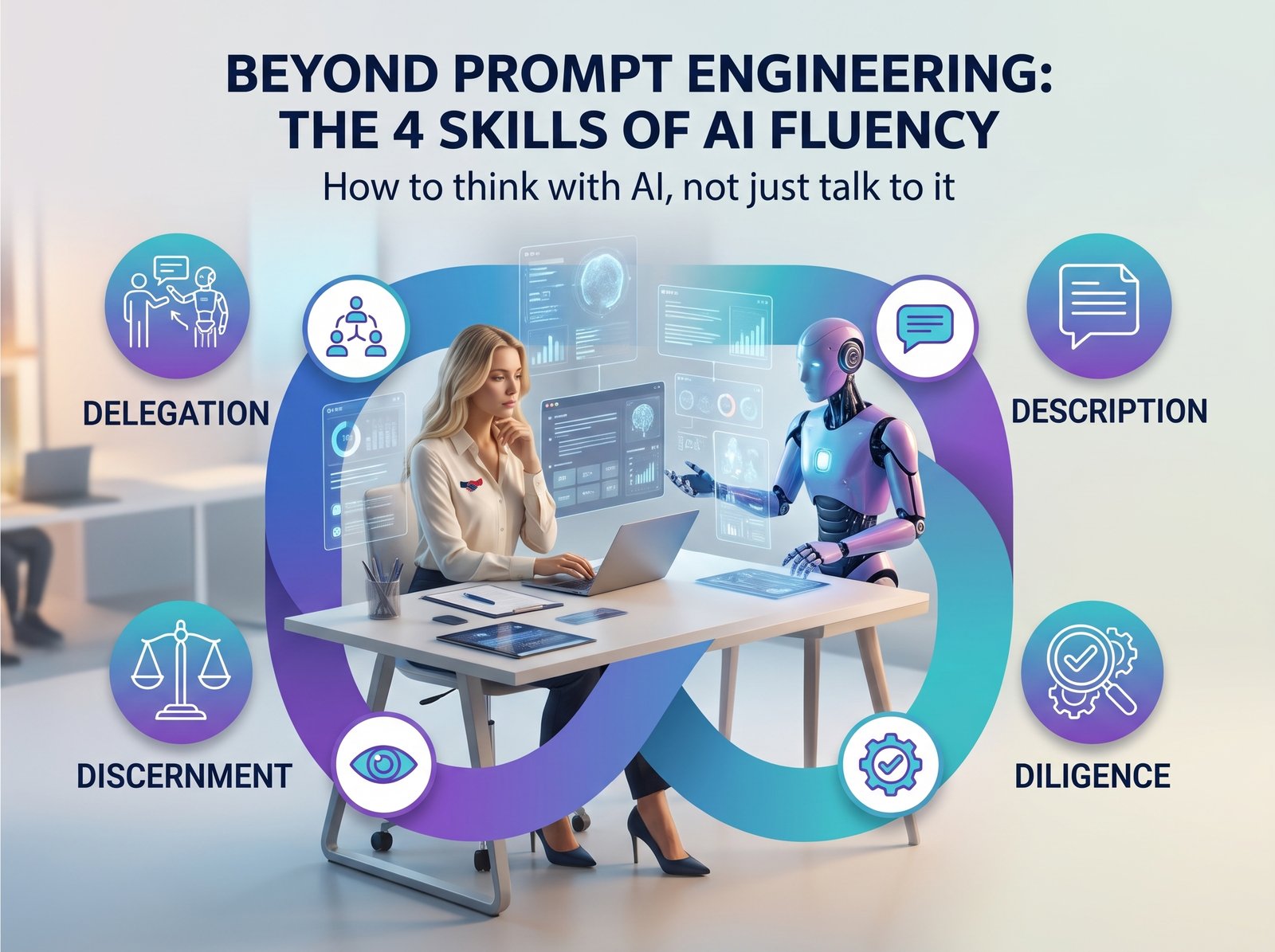
The framework I find most useful here was presented by Anthropic and the American Federation of Teachers (AFT) in their AI Fluency for pK–12 Educators training materials. It was developed for educators, but the underlying principles extend well beyond the classroom — to entrepreneurs, marketers, managers, developers, researchers, and business leaders. It introduces four competencies:
Delegation. Description. Discernment. Diligence.
1. Delegation — Just Because AI Can Do Something Doesn't Mean It Should
The first question isn't how to prompt AI. It's whether AI should be performing the task at all. Delegation is the ability to decide which responsibilities belong to AI, which require human involvement, and which should remain entirely human.
Consider a marketing manager preparing a new campaign. AI can help with:
- Researching audience segments
- Generating campaign ideas
- Drafting advertising copy
- Comparing messaging approaches
But should AI independently approve the final campaign budget? Should it publish advertisements without review? Should it decide which customer groups to exclude? Not necessarily — those decisions depend on business context, financial exposure, organisational policy, and human judgment.
Good delegation isn't about maximising automation. It's about assigning responsibility intelligently.
This matters even more as we move from conversational AI tools to autonomous agents. An agent that can access databases, send emails, modify records, or execute transactions introduces a different level of risk entirely. The question shifts from "Can AI perform this task?" to "Under what conditions should AI be authorised to perform this task?"
2. Description — AI Cannot Read Your Mind
Once we decide a task is appropriate for AI, the next challenge is explaining what we actually need. This is where prompt engineering becomes useful — but description is broader than clever prompting technique. It requires communicating the objective, the relevant context, the constraints, and the expected outcome.
Compare two instructions.
Example A: "Create a marketing campaign for my business."
Example B: "Act as a B2B marketing strategist. Develop three LinkedIn campaign concepts targeting IT managers in mid-sized companies. Focus on practical AI adoption, avoid exaggerated productivity claims, and provide a target audience, key message, call to action, and measurable success criteria for each concept."
Both use the same AI tool. The second provides a far clearer definition of success. The difference isn't magic — it's communication.
The same principle applies to software development. When asking an AI coding assistant to implement a feature, define not only what the feature does, but also:
- Existing behaviour — what must remain unchanged
- Security requirements — which constraints apply
- Data scope — what the feature may and may not access
- Verification — how success will be tested
- Hard limits — what the system must never do
The quality of AI collaboration depends heavily on the quality of our thinking beforewe write the prompt.
3. Discernment — A Confident Answer Is Not Necessarily a Correct Answer
This may be the most underestimated AI skill. AI systems produce convincing explanations, polished documents, realistic images, and professional-looking software. But convincing doesn't mean correct, and polished doesn't mean reliable.
Discernment is the ability to critically evaluate AI-generated output. Three situations make the point.
- A business analyst asks AI to summarise financial performance. The report looks excellent — but one of the figures was calculated incorrectly.
- A researcher asks AI to identify supporting studies. The response contains impressive-looking references — but some citations are inaccurate or don't support the claim.
- A developer asks an AI assistant to implement an authentication mechanism. The code works in basic testing — but contains a subtle authorisation vulnerability.
In all three cases the AI delivered something that looked useful. The problem wasn't generating an answer. The problem was determining whether the answer could be trusted.
This is where human expertise becomes critical. A financial professional recognises suspicious numbers. A researcher knows how to validate evidence. A security engineer knows what to test beyond basic functionality.
The easier AI makes content creation, the more important our ability to evaluate that content becomes.
There is a second lesson here. If we lack the expertise to evaluate an AI-generated result, we need an appropriate verification mechanism or a qualified reviewer. Blind confidence is not a verification strategy.
4. Diligence — AI Can Generate the Work, but You Still Own the Outcome
The final competency is about responsibility. Imagine using AI to draft an important email to a customer. The message contains an incorrect commitment. You send it without reviewing it. Who is responsible — the model, the company that built it, or the person who approved and sent the message?
In a professional environment, responsibility cannot simply be transferred to an algorithm. Diligence means taking ownership of how AI-generated output is validated, approved, disclosed where appropriate, and ultimately used. In practice it means asking:
- Have we verified the important facts?
- Are we exposing sensitive information?
- Does the output comply with our policies?
- Is human approval required?
- Can we explain how the decision was made?
- Can we correct or reverse an action if something goes wrong?
For an individual, diligence might mean reviewing a document before sending it. For an organisation, it means approval workflows, audit logs, access controls, and monitoring. For autonomous agents, it also means explicit permission boundaries, transaction limits, and mechanisms to stop unsafe operations.
Those technical controls are not replacements for human accountability. They are how accountability becomes operational. AI can assist with execution — it does not automatically inherit responsibility for the consequences.
The Real Power of the Framework: Two Connected Loops
One of the most interesting aspects of the Anthropic and AFT framework is how the four competencies work together, as two connected loops.
The inner loop: Description and Discernment
We explain what we need, evaluate the result, refine our instructions, and repeat. This is the iterative collaboration most people recognise from using tools like Claude or ChatGPT.
The outer loop: Delegation and Diligence
We decide whether the task should involve AI at all, determine the boundaries of that involvement, and take responsibility for the outcome. This loop surrounds the entire interaction — and that is precisely why it matters.
You can write a perfect prompt and still make a poor decision about what you delegated. You can receive a technically correct output and still use it irresponsibly. And sometimes, evaluating an AI-generated result reveals that the task should never have been delegated in its original form. That isn't a failure. That's good judgment.
From Everyday AI Use to Enterprise AI Agents
This framework becomes particularly relevant in the shift from AI assistants to AI agents. Consider a company deploying an autonomous customer-support agent. The four competencies translate directly into design decisions.
- Delegation — What can the agent do independently? Answer general questions? Update customer information? Issue refunds?
- Description — What instructions, customer context, business rules, and permission boundaries does the agent need?
- Discernment — How will we evaluate answer quality, detect errors, test exceptional cases, and recognise potentially harmful behaviour?
- Diligence — Who is accountable for the agent's actions? What must be logged? When is human approval mandatory? How is an incorrect action detected and corrected?
Notice what happened there. A framework originally presented for AI fluency in education maps cleanly onto the design of an enterprise AI system. The principles hold; only the implementation becomes more sophisticated.
The 4D framework is not a complete enterprise security or AI governance architecture. Production systems require additional technical controls, testing, monitoring, and risk management. But it provides an accessible way to think about the human responsibilities behind those controls — and that is why it deserves attention well beyond education.
Rethinking What It Means to Be Good at AI
For years, digital literacy meant knowing how to use technology. AI literacy added an understanding of what artificial intelligence is, how it works, and where its limitations lie. AI fluency goes further: it means collaborating with AI effectively, critically, and responsibly.
In our work building AI systems and helping organisations adopt them, the hardest challenges are rarely the technical ones. They involve judgment — knowing when to automate, how to define a problem, when to question a result, and when a human must remain in control.
We should absolutely keep teaching prompt engineering, AI tools, automation platforms, and agent development. But those are only part of the picture. A person who can generate an impressive answer is not necessarily AI fluent. A person who knows when to use AI, how to guide it, how to evaluate it, and how to take responsibility for its outcomes is much closer.
Key takeaway
The future won't belong to the people who can use the most AI tools. It will favour those who can combine AI capability with sound professional judgment — because the goal was never to remove humans from the process, but to make human decisions better.
How We Apply This in Practice
When we design agentic systems for clients, the 4D questions are architectural requirements rather than a reflective exercise. Delegation becomes a permission model that defines which actions an agent may take autonomously and which require approval. Description becomes explicit system contracts, tool scopes, and evaluation criteria. Discernment becomes quality gates and automated evaluation against known-good outcomes. Diligence becomes audit logging, human-in-the-loop checkpoints on irreversible actions, and the ability to revoke a credential or disable a tool without a redeployment.
The next time you use AI, it's worth pausing on four questions. Delegation: should AI be doing this? Description: have I clearly defined what success looks like? Discernment: how will I know if the result is correct? Diligence: am I prepared to take responsibility for the outcome?
Four questions — and a fundamentally different approach to working with AI than another collection of prompt templates.
Framework acknowledgment: the 4D Framework for AI Fluency — Delegation, Description, Discernment, and Diligence — is presented in the AI Fluency training materials developed by Anthropic and the American Federation of Teachers (AFT). The examples and interpretations extending these principles to business operations, software development, security, and autonomous AI agents reflect our own professional perspective.