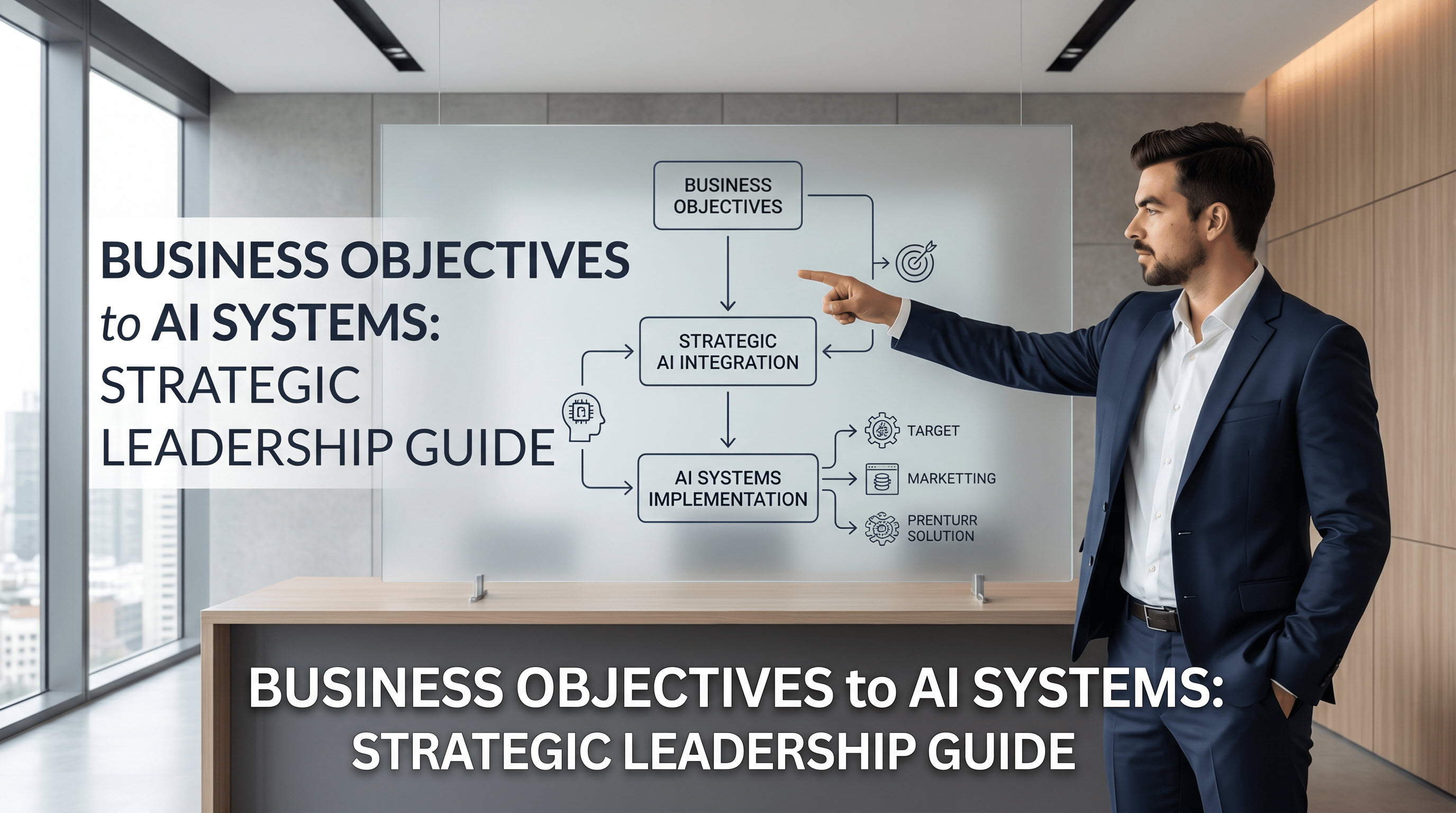
Most organizations approaching AI adoption make the same foundational mistake: they start with the technology. They evaluate models, run proofs of concept, and build demos before ever clearly articulating which business problem they are trying to solve. The result is wasted resources, growing skepticism, and AI initiatives that never graduate from experimentation to operational value.
The Wrong Starting Point
The technology-first approach to AI is understandable. AI capabilities are genuinely impressive. Demonstrations are compelling. And vendors, press coverage, and internal enthusiasm all push organizations toward experimentation. But experimentation without a defined problem to solve is not a path to value — it is a path to expensive distraction.
When the question being asked is "what can we do with AI?" rather than "what business problem do we need to solve?", every answer is technically correct and practically useless. There will always be something AI can do. The question that matters is whether that capability addresses a specific, measurable gap in how the organization operates or competes.
"Starting with AI models instead of business problems is the single most reliable way to generate impressive demos and produce zero durable value."
Eight Principles for Moving from Hype to Value
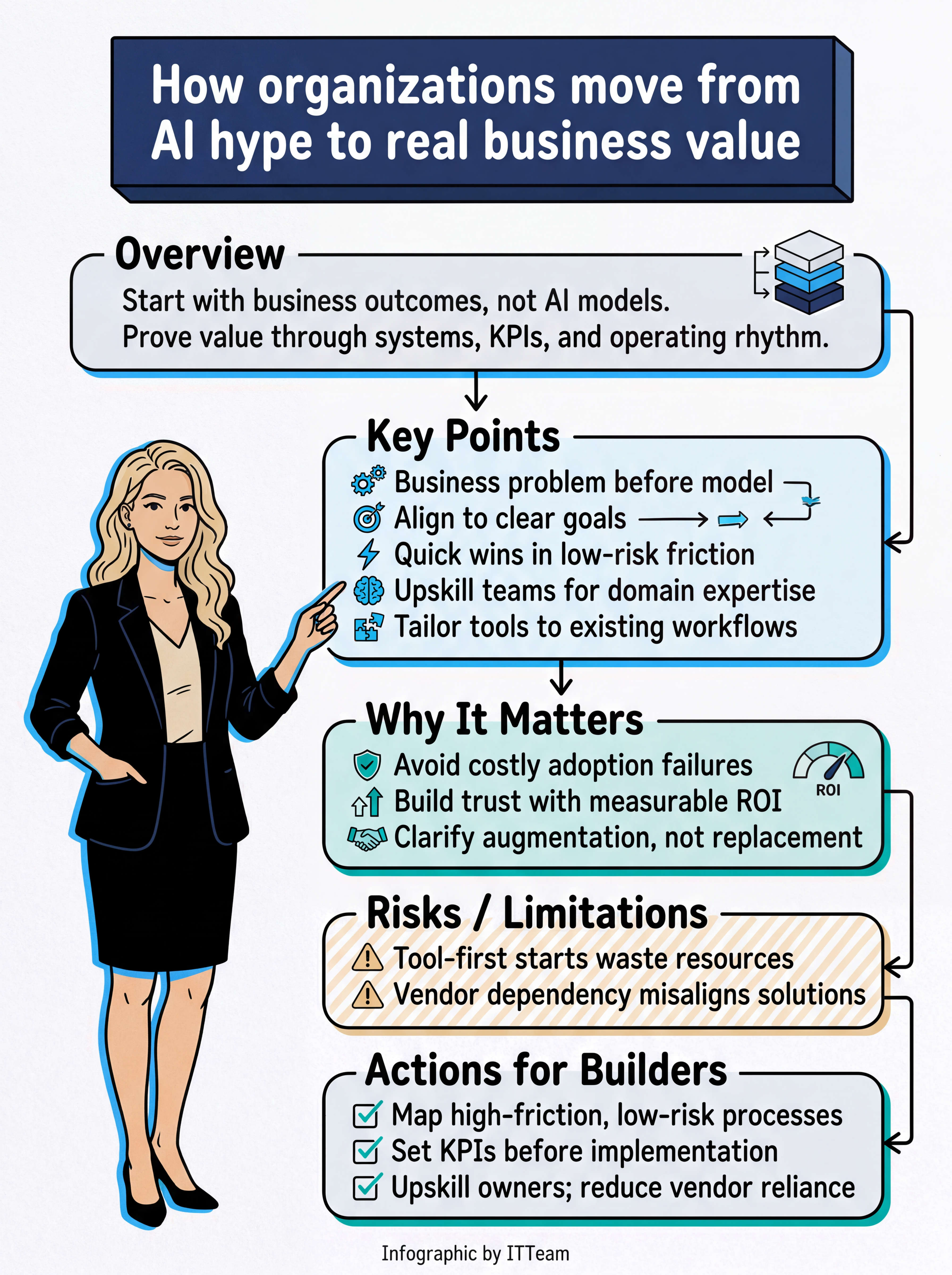
1. Align Every AI Initiative with a Clear Business Goal
Before any AI initiative moves past the conversation stage, it should be anchored to a specific, stated business objective — reducing repetitive manual work, compressing a slow operational cycle, improving the consistency of a customer-facing process. The goal must be explicit enough that success can eventually be measured.
This alignment disciplines the initiative from the outset. It determines which capabilities are relevant, which success metrics matter, and which stakeholders need to be involved. Without it, AI projects accumulate technically interesting work that produces no accountability for outcomes.
2. Prioritize Quick Wins in High-Friction, Low-Risk Areas
Organizational trust in AI is earned, not assumed. The fastest path to that trust is demonstrating clear, visible value in processes that are already painful — high-friction workflows where the current state is well understood and the cost of AI error is contained.
These early wins are not just business outcomes. They are trust-building exercises for the broader organization. When teams see AI reliably solving a problem they have lived with for years, the skepticism that surrounds larger, more ambitious AI initiatives begins to dissolve.
3. Establish Measurable ROI Early and Often
KPIs for AI initiatives must be defined before implementation begins — not retrofitted after the system is running. The question "how will we know if this worked?" needs a structural answer tied to business metrics: time saved, error rates reduced, throughput increased, cost per unit decreased.
The test of a credible AI initiative
If you cannot articulate a specific, measurable outcome before you start building, you do not have a business initiative — you have an experiment with no success criteria. Experiments are valuable. Experiments sold as transformation are not.
Early ROI demonstration also protects the initiative politically. AI projects that cannot show measurable progress lose executive support before they reach scale. Defining KPIs early creates checkpoints where momentum can be evidenced, not just asserted.
4. Build Domain-Specific Solutions, Not Generic Ones
Generic AI tools applied to specific problems almost always underperform purpose-built solutions. The reason is straightforward: domain specificity is where the value lives. The nuances of a particular workflow, the edge cases endemic to a specific industry, the language and logic of a given operational context — these are what separate useful AI from AI that technically functions but does not actually help.
Domain-specific AI solutions require deeper investment upfront. They take longer to scope, require more subject matter input, and are harder to sell as horizontal platforms. But they produce materially better outcomes and integrate more naturally into the environments where they are deployed.
5. Integrate Seamlessly into Existing Workflows
AI that requires users to change how they work in order to benefit from it faces adoption resistance that technical quality cannot overcome. The adoption burden is a design failure, not a change management problem. The system should come to the user, not require the user to come to the system.
Seamless integration means understanding the existing workflow before designing the AI layer — what tools people actually use, how decisions are currently made, where handoffs happen, and what friction looks like in practice. AI that reduces friction in a familiar context is adopted. AI that creates new friction in the name of capability is not.
6. Upskill Internal Teams to Build Domain Expertise
Organizations that rely entirely on external vendors for AI capability are trading short-term convenience for long-term dependency. The vendors understand their platforms. They do not understand the organization's operations, competitive pressures, or the specific ways AI failure would damage trust with specific stakeholders.
Internal AI expertise is not about replacing vendors. It is about building the organizational capacity to evaluate vendor claims, define requirements precisely, recognize when systems are degrading, and make architectural decisions that reflect actual business priorities rather than what is easy to sell.
7. Communicate Clearly About Augmentation Versus Replacement
Ambiguity about whether AI is augmenting human work or replacing it generates resistance that undermines adoption even when the business case is sound. People will not engage productively with a system they believe is designed to eliminate their role.
Clarity here is both ethically important and strategically necessary. Organizations that have explicit, honest conversations about what AI is being designed to do — and what human judgment it is designed to support rather than supplant — build the internal conditions that allow AI adoption to succeed.
8. Treat AI as an Ongoing Operating Rhythm, Not a One-Off Project
AI initiatives that are scoped as projects — with defined start and end dates, fixed deliverables, and project-style governance — systematically underperform their potential. They are built for a moment in time, optimized for initial performance, and then left to degrade as the environment around them changes.
Durable AI value requires treating AI as an operational capability: something maintained, improved, and evolved continuously as organizational needs change and AI capabilities advance. This means building feedback loops, monitoring for degradation, establishing review cadences, and allocating ongoing resources for improvement rather than treating the initial build as the end of the investment.
The principle that matters
Every AI initiative that produces durable value started with a business problem. Every AI initiative that produced impressive demos and no lasting impact started with a model. The order of operations is not a detail — it determines the outcome.
How We Apply This in Practice
In every engagement, we begin with business problem definition before any conversation about AI architecture, model selection, or tooling. We map the specific frictions in the current workflow, establish the success criteria that will define whether the initiative worked, and identify the lowest-risk, highest-friction processes where early wins are achievable.
We also insist on integration design that meets users where they already work. The AI system should reduce the cognitive load of the existing workflow — not add a new one. And we structure every engagement to leave the organization more capable of evaluating, maintaining, and evolving its AI systems independently — not more dependent on external support to sustain what was built.
The organizations that move from AI hype to real business value are not the ones with the most advanced models. They are the ones that asked the right questions first, built for specific outcomes, and treated AI as a continuous operating discipline rather than a one-time transformation project.