A production-ready agentic AI system is not a single model with a prompt around it. It is a small set of cooperating components — orchestration, specialized agents, memory, tools, guardrails, and observability — each with a clear responsibility. This reference diagram and walkthrough show how those layers fit together.
Why a Reference Diagram Matters
Most agentic AI projects that stall in production stall for the same reason: the team built around a framework instead of around an architecture. A reference diagram is the antidote. It forces the conversation back to what the system has to do — and where each responsibility lives — before any framework decision is made.
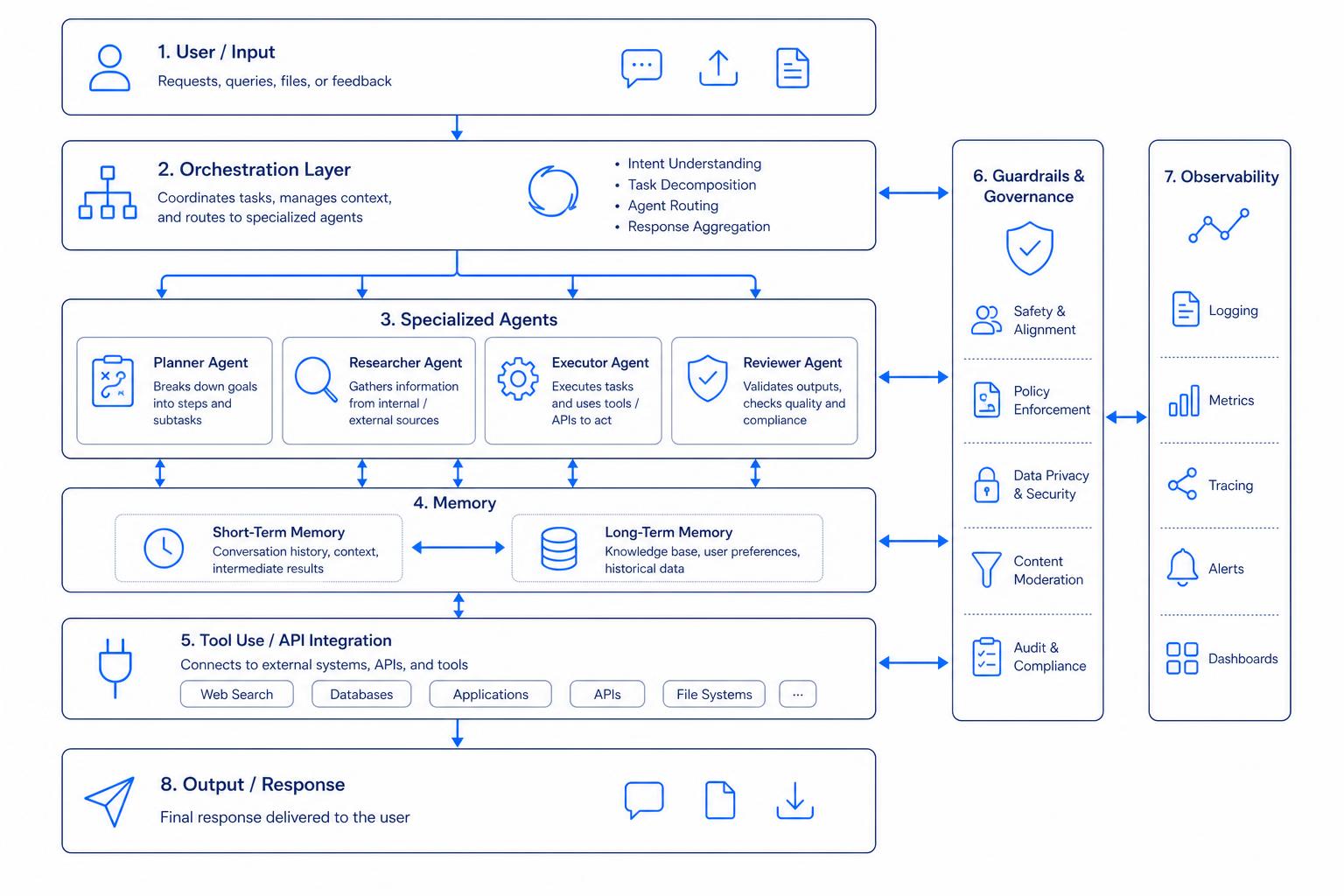
The diagram above is intentionally framework-neutral. It works whether the underlying orchestration is LangGraph, CrewAI, AutoGen, or a custom controller. The layers are what matter; the implementation choices come after.
The Eight Layers of a Production Agentic System
1. User / Input
The entry point. Requests, queries, uploaded files, or feedback from upstream systems. The important design decision here is contract clarity: what shape does input take, what is validated at the edge, and what the orchestrator can assume by the time it receives a request.
2. Orchestration Layer
The orchestrator coordinates the work. It interprets intent, decomposes goals into tasks, routes those tasks to the right specialized agents, and aggregates results back into a coherent response. In a well-designed system the orchestrator owns control flow — not the agents themselves — which is what makes the system auditable and predictable under load.
3. Specialized Agents
Each agent has one job. A typical decomposition includes:
- Planner — breaks goals into ordered subtasks
- Researcher — gathers context from internal and external sources
- Executor — calls tools and APIs to take action
- Reviewer — validates outputs against quality and policy criteria
The number of agents is a function of the workflow, not a target in itself. Two well-scoped agents beat six overlapping ones every time.
4. Memory
Memory is split deliberately. Short-term memory holds conversation history, intermediate results, and per-task context. Long-term memoryholds knowledge bases, retrieval indices, user preferences, and historical interactions. Separating the two prevents a common failure mode: context windows that quietly degrade reasoning quality because everything is treated as equally relevant.
5. Tool Use / API Integration
The system's reach into the outside world — databases, internal APIs, business applications, file systems, web search. Tools should be defined with explicit inputs, explicit outputs, and explicit error semantics. An agent calling a tool should never need to guess what a successful response looks like.
6. Guardrails and Governance
Cross-cutting controls that apply at every layer: safety and alignment checks, policy enforcement, data privacy and security boundaries, content moderation, and audit compliance. Governance is not a wrapper around the system — it is wired into the orchestrator, the agents, and the tool layer simultaneously.
7. Observability
Logging, metrics, distributed tracing, alerts, and dashboards. Without observability, an agentic system fails silently — quality drifts, costs creep, and no one notices until a customer does. The observability layer is what turns a black-box AI system into something an operations team can actually run.
8. Output / Response
The final response delivered to the user or upstream caller. Output should be schema-validated and traceable back through the orchestrator to the agents and tool calls that produced it.
How the Layers Interact
The flow is intentionally one-directional through the core path — input enters the orchestrator, which dispatches to agents, which consult memory and call tools, and whose results return through the orchestrator to the output. Guardrails and observability sit beside the core path and apply across every layer, not inside any one of them.
This separation matters. When governance is embedded inside an individual agent's prompt, it cannot be updated without redeploying that agent. When governance sits as its own layer, policy changes are configuration — not code.
Agentic AI systems do not fail because the model is wrong. They fail because responsibility is not distributed clearly across the architecture.
Common Mistakes This Diagram Helps Prevent
- Skipping the orchestration layer. When agents call each other directly, control flow becomes implicit and impossible to audit.
- One agent doing everything. A single "do-it-all" agent recreates every problem of monolithic AI inside an agentic framework.
- Treating memory as one bucket. Mixing short-term context with long-term knowledge dilutes both.
- Wrapping governance around the outside. Policy enforcement that only runs at the edge cannot catch tool calls or inter-agent decisions.
- Adding observability last. If logging and tracing are not designed in from day one, root-cause analysis in production becomes guesswork.
Using This Diagram in Practice
Before any framework decision, map your intended workflow onto these eight layers. For each layer, answer three questions: What is its responsibility? What is its interface? How is it observed? If any layer cannot be answered cleanly, the architecture is not ready to be implemented — and choosing a framework will not fix it.
Once those answers are stable, the framework choice becomes much smaller. LangGraph, CrewAI, AutoGen, or a custom controller are then evaluated against a defined architecture, not asked to define it.
Key takeaway
A reference diagram is not documentation produced after the build — it is the contract the build is held to. Use the eight layers to define responsibility, interfaces, and observability before you choose tools. That is the difference between an agentic prototype and an agentic system.